You can access the distribution details by navigating to My pre-printed books > Distribution
Add a Review
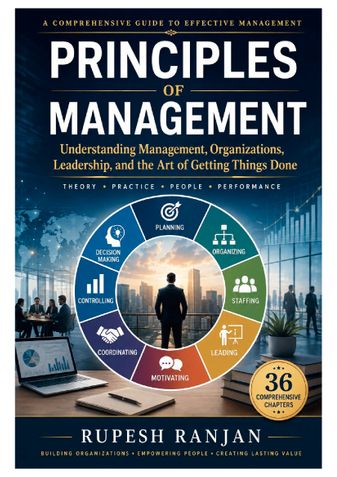
Principles of Management (eBook)
Understanding Management, Organizations, Leadership, and the Art of Getting Things Done
Type:
e-book
Genre: Business & Economics, Education & Language
Language: English
Price:
₹171
(Immediate Access on Full Payment)
Description
Principles of Management
Understanding Management, Organizations, Leadership, and the Art of
Getting Things Done
Author: Rupesh Ranjan
Management is at the heart of every successful organization. Whether the organization is a business,
government institution, educational establishment, hospital, nonprofit organization, startup, or
community initiative, its ability to achieve meaningful objectives depends upon how effectively
people, resources, information, technology, and responsibilities are managed.
Principles of Management presents a comprehensive and accessible exploration of management as
both a professional discipline and a practical human activity. The book explains how organizations
establish objectives, develop plans, organize resources, manage people, make decisions, coordinate
activities, motivate employees, exercise leadership, resolve conflicts, measure performance, and
adapt to changing circumstances.
Beginning with the foundations of management, the book examines the meaning, nature,
importance, and evolution of management thought. It introduces readers to classical principles while
demonstrating how management ideas have developed in response to changing organizational,
economic, technological, and social conditions.
The book then moves systematically through the major functions of management. Planning and
decision-making explain how managers establish objectives, develop strategies, evaluate alternatives,
manage risks, solve problems, and respond to uncertainty. Organizing and coordination examine
organizational structures, authority, responsibility, delegation, decentralization, empowerment, and
the integration of different organizational activities.
A major emphasis of the book is placed on the human dimension of management. Organizations are
not merely structures or systems; they are communities of people. Recruitment, selection, training,
development, performance management, motivation, employee engagement, and leadership are
therefore explored as essential components of organizational success.
The book also examines communication, teamwork, organizational behavior, conflict management,
negotiation, organizational culture, diversity, and inclusion. These areas demonstrate why
managerial effectiveness depends not only on technical knowledge but also on the ability to
understand people, build trust, encourage cooperation, and manage differences constructively.
The later chapters connect traditional management principles with the challenges of the
contemporary world. Managerial control, financial and resource management, operations, quality,
productivity, ethics, corporate governance, and social responsibility are examined alongside
emerging issues such as digital transformation, artificial intelligence, automation, remote work,
cybersecurity, globalization, sustainability, and organizational resilience.
A central feature of the book is its attempt to balance theory with practical understanding.
Management principles are not presented as rigid formulas that can be applied identically in every
situation. Organizations differ in size, purpose, culture, resources, technology, people, and external environment. Effective managers must therefore understand principles while developing the
judgment and adaptability required to apply them appropriately.
The book also emphasizes the distinction between efficiency and effectiveness. Efficient management
seeks to use resources wisely, while effective management seeks to achieve meaningful objectives.
True managerial excellence requires both. An organization should not simply do things efficiently; it
should ensure that it is doing the right things and creating sustainable value.
In the contemporary environment, managers face challenges that previous generations could
scarcely have imagined. Artificial intelligence and automation are changing jobs and organizational
processes. Digital communication is transforming collaboration. Globalization has created
interconnected markets and multicultural workplaces. Environmental concerns are influencing
organizational strategies. Employees increasingly expect meaningful work, fairness, flexibility,
development opportunities, and respectful workplaces.
These changes do not make traditional management principles irrelevant. Instead, they make them
more important. Planning, organizing, leadership, communication, motivation, coordination,
decision-making, and control remain fundamental, but they must now be applied with greater
flexibility, technological awareness, ethical responsibility, and human understanding.
The book is intended for a broad readership, including:
Students studying management, business, commerce, economics, public administration, and
related disciplines.
Professionals and managers seeking to strengthen their managerial knowledge and capabilities.
Entrepreneurs and business owners interested in building effective organizations and teams.
Administrators and public-sector professionals dealing with organizational planning, resources,
people, and institutional performance.
Researchers and educators seeking a broad framework for understanding management.
General readers interested in leadership, organizations, productivity, decision-making, and human
behavior.
Across its 36 chapters, the book follows a structured journey from the basic foundations of
management to the emerging challenges of the future. It seeks to answer fundamental questions:
What is management?
Why is management important?
How should organizations plan and organize their activities?
How can managers make better decisions?
How can people be motivated and developed?
What makes an effective leader?
How can organizations manage conflict and change?
How should managers respond to technology, globalization, and uncertainty?
What makes management ethical, responsible, and sustainable?
At its deepest level, management is about coordinating human effort toward a shared purpose. It
involves transforming ideas into plans, plans into actions, and actions into results. But successful
management also requires understanding that organizational results should not be pursued at the
expense of people, integrity, or long-term sustainability. The philosophy underlying this book can therefore be summarized in a simple principle:
Good management is not merely the ability to get work done. It is the ability to achieve the right
objectives, through people, resources, and responsible decisions, while creating lasting value.
Principles of Management is ultimately an invitation to understand organizations more deeply and to
view management not simply as authority or administration, but as a combination of knowledge,
discipline, leadership, judgment, cooperation, innovation, and human responsibility.
Through its comprehensive 36-chapter structure, the book aims to provide readers with a strong
foundation for understanding both the traditional principles and the evolving practice of management
in the twenty-first century.
About the Author
Book Details
Number of Pages: 656
Availability:
Available for Download (e-book)
Ratings & Reviews
Principles of Management
Review This Book
Write your thoughts about this book.

Currently there are no reviews available for this book.
Be the first one to write a review for the book Principles of Management.
Other Books in Business & Economics, Education & Language

Rajiv Kumar


নুরুল মোস্তফা কামাল জাফরী

Yashda Garg, Mehak Garg