You can access the distribution details by navigating to My pre-printed books > Distribution
Add a Review
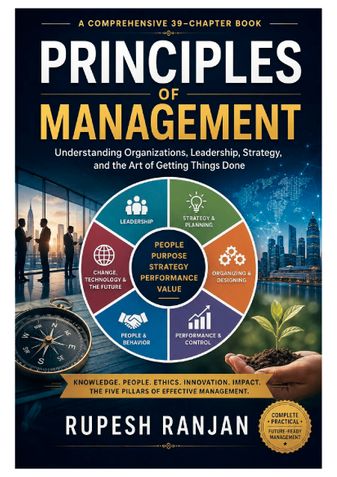
PRINCIPLES OF MANAGEMENT (eBook)
Understanding Organizations, Leadership, Strategy, and the Art of Getting Things Done
Type:
e-book
Genre: Business & Economics, Education & Language
Language: English
Price:
₹181
(Immediate Access on Full Payment)
Description
PRINCIPLES OF MANAGEMENT
Understanding Organizations, Leadership, Strategy, and the Art of
Getting Things Done
Author: Rupesh Ranjan
Principles of Management is a comprehensive and independently written exploration of management
as a discipline, a professional responsibility, an organizational process, and a practical art of
achieving collective objectives. Designed as a 39-chapter book, it presents management not merely as
the supervision of employees or the administration of business activities, but as a multidimensional
process involving people, strategy, resources, technology, decision-making, innovation, ethics, and
organizational purpose.
Every organized activity requires some form of management. Businesses must allocate resources
and serve customers. Governments must implement policies and deliver public services. Educational
institutions must develop people and manage knowledge. Hospitals must coordinate professionals and
resources. Nonprofit organizations must pursue social objectives with limited resources. Startups
must transform ideas into sustainable ventures. In each of these settings, management determines
how effectively people and resources are brought together to achieve desired outcomes.
This book begins with the fundamental question: What is management, and why does it matter? It
then progressively develops the reader's understanding through the major dimensions of managerial
thought and practice.
The opening chapters establish the foundations of management, examining its meaning, nature,
importance, historical evolution, functions, levels, roles, skills, and competencies. The book
introduces classical and modern approaches while recognizing that management continues to evolve
as organizations and societies change.
The second major section focuses on planning and decision-making. No organization can operate
effectively without some understanding of its objectives, priorities, resources, opportunities, and
risks. The book examines planning at different levels, strategic management, organizational
direction, managerial decision-making, problem-solving, creativity, innovation, Management by
Objectives, and performance planning.
The discussion then moves to organizing and organizational design. Even a sound strategy can fail
when responsibilities are unclear, authority is poorly distributed, departments do not coordinate, or
organizational structures become unnecessarily rigid. The book therefore explores specialization,
departmentation, delegation, decentralization, organizational structures, authority, power,
accountability, coordination, and integration.
A major emphasis is placed on the human dimension of management. Organizations are ultimately
created and operated by people. For this reason, the book examines human resource management,
motivation, employee engagement, leadership, organizational behavior, teamwork, organizational
culture, communication, conflict management, negotiation, and workplace relationships.
The book recognizes that effective management requires both human understanding and systematic performance management. Its discussion of control, performance, and organizational effectiveness
therefore covers managerial control, performance measurement, quality management, continuous
improvement, operations, productivity, and financial management. These subjects demonstrate how
organizations can translate plans into measurable outcomes while maintaining efficiency, quality, and
accountability.
The later sections address the rapidly changing environment in which contemporary organizations
operate. Marketing, entrepreneurship, digital transformation, organizational change, risk
management, crisis management, and resilience are examined as essential components of modern
management. The emergence of artificial intelligence, automation, digital platforms, data-driven
decision-making, remote work, and technological disruption has changed the nature of managerial
work. Managers increasingly need to understand not only traditional organizational principles but
also how technology affects people, processes, markets, and strategic choices.
The final section places management within a broader social and global context. Business ethics,
corporate governance, corporate social responsibility, sustainability, diversity, inclusion, global
management, cross-cultural organizations, knowledge management, organizational learning, and the
future of management are examined as increasingly important dimensions of organizational success.
One of the central arguments of the book is that management cannot be reduced to a single formula.
Organizations differ in size, purpose, structure, resources, culture, technology, environment, and
stakeholders. What works for a small entrepreneurial organization may not work for a large
corporation. What is appropriate in a stable environment may become ineffective during a crisis. A
highly centralized structure may provide control in one situation but restrict innovation in another.
Consequently, effective managers require more than technical knowledge. They need judgment,
adaptability, communication, emotional intelligence, analytical ability, ethical awareness, strategic
thinking, and the capacity to work with people.
The book also emphasizes the distinction between efficiency and effectiveness. Efficiency concerns
the intelligent use of resources, while effectiveness concerns the achievement of appropriate
objectives. An organization that uses resources efficiently but pursues the wrong objectives cannot be
considered truly successful. Conversely, an organization with an inspiring purpose but poor
execution may fail to convert its vision into meaningful results. Management therefore requires a
continuous balance between purpose and performance.
Leadership receives particular attention because modern organizations increasingly depend upon
knowledge, collaboration, innovation, and employee initiative. Managers cannot rely exclusively on
authority. They must be able to create trust, communicate purpose, resolve disagreements,
encourage participation, develop talent, and inspire people to contribute beyond minimum
requirements.
Another important theme is responsible management. Organizations influence society, and
managerial decisions can have consequences far beyond the organization itself. Questions
concerning corporate governance, ethical conduct, sustainability, social responsibility, employee
welfare, transparency, and stakeholder interests therefore form an integral part of contemporary
management.
The book ultimately presents management as a discipline that connects ideas with action.
A manager must be able to identify objectives, understand circumstances, develop plans, organize
resources, select and develop people, communicate expectations, make decisions, solve problems, measure performance, manage risks, respond to change, and learn from experience. Management is
therefore simultaneously analytical and human, strategic and operational, structured and adaptive.
A Book for a Wide Range of Readers
This book is intended for:
Management and MBA students seeking a broad conceptual foundation.
Undergraduate students studying principles of management and organizational studies.
Managers and working professionals seeking to strengthen their managerial understanding.
Entrepreneurs and startup founders dealing with strategy, people, finance, innovation, and
growth.
Public administrators and institutional leaders interested in planning, coordination,
accountability, and organizational effectiveness.
Teachers and researchers looking for an organized framework for studying management concepts.
General readers interested in understanding how organizations function and why some
organizations succeed while others struggle.
The Central Philosophy of the Book
The underlying philosophy of this book can be expressed simply:
Management is the disciplined process of converting collective human and organizational potential
into meaningful, sustainable results.
This requires much more than giving instructions. It requires creating a clear purpose, developing
capable people, allocating resources wisely, encouraging responsible innovation, establishing
effective systems, learning continuously, and adapting intelligently to change.
The future of management will increasingly involve the interaction of human intelligence, artificial
intelligence, organizational knowledge, technology, sustainability, and ethical responsibility. The
managers of tomorrow will need to understand machines without losing sight of people, pursue
performance without abandoning ethics, embrace innovation without ignoring risk, and seek growth
without compromising long-term sustainability.
Thus, this book does not treat management as a static body of knowledge. It presents management as
an evolving discipline—one that must continuously respond to technological transformation,
changing employee expectations, global competition, environmental challenges, economic
uncertainty, social transformation, and new forms of organizational work.
What Readers Can Take Away
By studying this book, readers can develop a broad understanding of:
Management fundamentals → Planning → Strategy → Decision-making → Problem-solving →
Organizing → Delegation → Organizational design → Human resources → Motivation →
Leadership → Organizational behavior → Teams → Culture → Communication → Conflict
management → Control → Performance → Quality → Operations → Finance → Marketing →
Entrepreneurship → Technology → Change → Risk → Ethics → Sustainability → Diversity →
Global management → Knowledge management → Future-oriented leadership.
The book's ultimate objective is not simply to provide information. It is to encourage readers to think
like managers—to analyze situations systematically, recognize relationships between organizational factors, evaluate alternatives, understand people, anticipate challenges, make responsible decisions,
and translate ideas into effective action.
In this sense, Principles of Management is both a foundational management text and a broader
reflection on how organized human effort can be transformed into productive, responsible, and
sustainable achievement.
A Final Thought
Organizations are built by people, but they are shaped by the quality of the systems, decisions,
relationships, leadership, and values through which those people work.
Good management creates clarity where there is confusion, coordination where there is
fragmentation, direction where there is uncertainty, opportunity where there is limitation, and
learning where there is failure.
Ultimately, the purpose of management is not merely to get things done.
It is to ensure that the right things are done, in the right way, by the right people, for the right
purpose—and that the organization becomes more capable of creating value tomorrow than it was
today.
— Rupesh Ranjan
Author
About the Author
Book Details
Number of Pages: 842
Availability:
Available for Download (e-book)
Ratings & Reviews
PRINCIPLES OF MANAGEMENT
Review This Book
Write your thoughts about this book.

Currently there are no reviews available for this book.
Be the first one to write a review for the book PRINCIPLES OF MANAGEMENT.
Other Books in Business & Economics, Education & Language

Gary Christ, Gaurav Bhagat

VIKESH KUMAR SINGH


Ashutosh Sharma