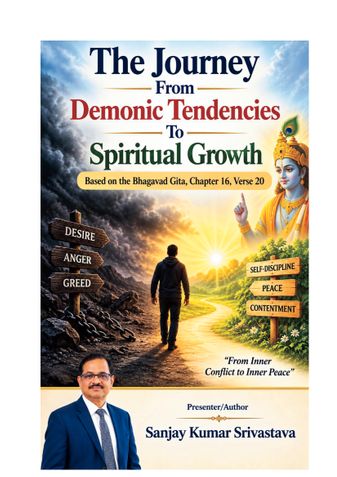
Sanjay Kumar Srivastava is a retired senior professional from the power sector who spent a significant part of his professional career serving Power Grid Corporation of India Limited (POWERGRID) in various responsibilities. Earlier, he also served with NTPC, where he gained valuable experience in power-sector projects, operations, and organizational practices.
Throughout his professional career, he placed particular importance on discipline, dedication to duty, responsibility, teamwork, and continuous learning. These professional experiences have also influenced his understanding of responsibility, decision-making, human relationships, and ethical conduct in everyday life.
Alongside his professional career, the author has maintained a deep interest in Indian culture, spiritual reflection, ethical values, and the philosophy of life presented in the Bhagavad Gita. In his view, human life is not limited to material achievements, professional position, or financial progress. The deeper values of life are also reflected in the way a person manages thoughts, desires, emotions, actions, duties, and responsibilities.
Inspired by this perspective, the author has attempted to explore the message of the Bhagavad Gita, Chapter 16, Verse 20, and present it in a simple and accessible manner for the modern reader. The verse describes the consequences of continuing on a path governed by destructive and unrighteous tendencies. The author seeks to understand this teaching not merely from a religious or philosophical perspective, but also in relation to everyday life, family relationships, professional environments, and social behaviour.
A central idea presented by the author is that overcoming negative tendencies does not mean eliminating all human desires, emotions, or material needs. Rather, it means learning to guide them wisely. Uncontrolled desire can be transformed through self-discipline and purposeful action; anger can be approached through patience, understanding, and constructive communication; and excessive attachment to material gain can be balanced through contentment, generosity, and responsible living.
Thus, the emphasis is not simply on “renunciation,” but on “transformation.” The objective is to understand our tendencies, develop self-awareness, and gradually transform those tendencies that create conflict, suffering, or imbalance into qualities that support personal and spiritual growth.
The author also places particular importance on self-reflection. He believes that meaningful positive change begins within the individual. When a person honestly observes their thoughts and behaviour, recognizes their weaknesses, and sincerely works towards improvement, the resulting changes may positively influence not only personal life but also family relationships, professional conduct, and interactions within society.
The purpose of this book is not to preach or instruct the reader, but to encourage reflection on the profound message of the Bhagavad Gita. The author's aim is to present ancient wisdom in a simple and relatable manner so that modern readers can connect its teachings with situations and challenges encountered in everyday life.
This book is therefore offered as a humble effort for readers who wish to move towards self-reflection, self-discipline, discernment, ethical conduct, and responsible living. The author hopes that reading and reflecting upon these teachings will encourage readers to look within themselves, understand their thoughts and actions, and take meaningful steps towards positive personal and spiritual growth.