You can access the distribution details by navigating to My pre-printed books > Distribution
Add a Review
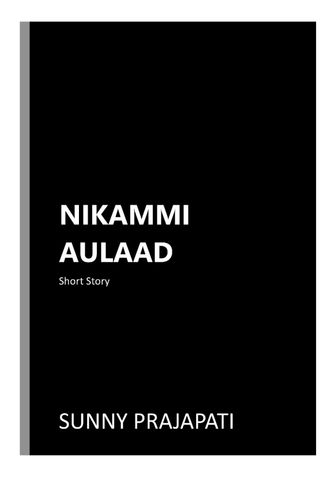
Nikammi Aulaad (निकम्मी औलाद) (eBook)
Type:
e-book
Genre: Philosophy, Parenting & Families
Language: Hindi
Price:
₹69
(Immediate Access on Full Payment)
Description
Nikammi Aulaad – An Extended Description (Part 1/4)
Introduction
Nikammi Aulaad (Worthless Offspring) is not merely a short story; it is a social mirror, a tale of human fragility, and a reflection of how family disputes, greed, and generational conflict consume the very roots of relationships. Written by Sunny Prajapati, the narrative is set in a small village in Uttar Pradesh, but its themes echo across rural and urban India — and indeed, across the world.
At its core, the story revolves around a family torn apart by land disputes, ego, and suspicion. Yet beneath the surface lies a deeper meditation: the pain of aging parents abandoned by their children, the erosion of human values under political manipulation, and the tragedy of migration, which separates generations and leaves behind only silence, longing, and betrayal.
The novel’s title, Nikammi Aulaad, directly challenges society: what happens when the very children who are supposed to be a blessing turn out to be indifferent, selfish, or unworthy of the sacrifices made for them? In exploring this question, Prajapati does not only tell a story but delivers a moral critique and a cry for reflection.
The Village as a Living Character
The setting of the story — the village of Bijouli in Etawah district — is not just a backdrop but a living character. The soil is described as fragrant with traditions, history, and countless stories of survival. The opening descriptions bring forth a sensory immersion: the muddy paths, the pond that reflects the dreams of young boys, the smell of harvests, the sound of temple bells, and the sight of youths running barefoot with aspirations of joining the Indian Army.
This landscape is crucial. The land is more than property — it is pride, survival, and inheritance. The paddy fields, wheat stalks, and mustard blossoms do not simply symbolize food but embody dignity. Losing the land, therefore, is equivalent to losing identity, which explains why disputes over even a single pond-side plot become explosive enough to destroy families.
Sunny Prajapati paints rural life in layers:
The elders on the charpai (cot), reliving memories and disputes.
The women sweeping courtyards at dawn, praying at tulsi plants, carrying dreams for their children.
The children laughing, running to school, bathing in ponds.
This delicate depiction of rural harmony sets the stage for the tragic unraveling that follows.
Early Conflict – A Family Divided
At the center are two brothers: Ramotar and Sukhlal. Once bound by blood and common struggle, they gradually become victims of land-related disputes and the poisonous manipulations of the village head, Ram Lal Trivedi.
The conflict begins over expenses from rituals after their father’s death. Ramotar claims that he bore more financial burden and therefore deserves land compensation. What seems at first a manageable disagreement turns into a decades-long animosity.
As hardship deepens due to drought and crop failure, the family’s fragile bond fractures further. Land, once tilled together, becomes a battlefield. The pond-side field, in particular, becomes a curse rather than a blessing, for its fertility fuels envy, suspicion, and accusations of unfair possession.
Migration and Displacement
Another layer that adds intensity is migration. When drought strikes and harvests fail, many villagers begin migrating to cities. At first, it appears to be a necessity, but soon it becomes a trend, a fashion. Sons who once dreamed of serving the nation in uniform now dream of wages in Delhi, Kanpur, or Lucknow.
Migration, in the story, is not just a geographical shift but a symbol of generational betrayal. Sons leave not only their village but also their........
About the Author
Book Details
ISBN: 9789334373080
Publisher: Shiva Publication
Number of Pages: 33
Availability:
Available for Download (e-book)
Ratings & Reviews
Nikammi Aulaad (निकम्मी औलाद)
Review This Book
Write your thoughts about this book.

Currently there are no reviews available for this book.
Be the first one to write a review for the book Nikammi Aulaad (निकम्मी औलाद).
Other Books in Philosophy, Parenting & Families
پاگل پنڈت

Prashna

Pradip Kumar Ray
Pramod Saxena