You can access the distribution details by navigating to My Print Books(POD) > Distribution
Add a Review
Description
Contents
Volume I - Prehistory and Protohistory 1
Chapter 1. Region, rivers, names, and method 2
Chapter 2. Archaeology and early food production 20
Chapter 3. Late prehistoric and early iron-using horizons 36
Chapter 4. Environment, mobility, and settlement 52
Volume II - Ancient Mithila, Vajji and Anga 67
Chapter 5. Videha in Vedic and Upanishadic textual worlds 68
Chapter 6. Janaka, Sita, and the discipline of reading tradition 85
Chapter 7. Vajji, the Licchavis, and Vaishali 105
Chapter 8. Anga, Champa, and the Magadhan horizon 126
Chapter 9. Buddhism, Jainism, and eastern Gangetic religious change 139
Chapter 10. Empires, inscriptions, and pilgrim itineraries 161
Chapter 11. Licchavi Nepal and the problem of continuity 182
Volume III - Medieval Period 204
Chapter 12. Tirabhukti and the early-medieval regional order 205
Chapter 13. The Karnatas and Simraongarh 227
Chapter 14. Oiniwar rule, Sultanate power, and political transition 252
Chapter 15. Two Vidyāpatis: Maithili, Sanskrit learning, and law 274
Chapter 16. Mughal-era Tirhut, Anga, and early-modern institutions 298
Volume IV - Modern Period 323
Chapter 17. Company rule, Permanent Settlement, and Darbhanga Raj 324
Chapter 18. Agrarian society, markets, caste, and labour 350
Chapter 19. Rivers, calamity, transport, and the colonial state 372
Chapter 20. Education, print, language, reform, and nationalism 393
Chapter 21. The Nepal Tarai, Rana rule, and the border to 1951 419
Volume V - Contemporary Period 442
Chapter 22. Land reform, democracy, and changing regional power 443
Chapter 23. The India-Nepal borderland, migration, and exchange 458
Chapter 24. Maithili and Angika: language, literature, and recognition 477
Chapter 25. Mithila painting, gender, and the cultural economy 499
Chapter 26. The Kosi, floods, infrastructure, and environmental risk 524
Chapter 27. Madhesh, representation, and plural citizenship in Nepal 554
Chapter 28. Conclusions: connected histories without false unity 588
Consolidated chronology 617
Glossary and place-name concordance 635
General source register 654
Index 679
List of maps, figures and diagrams
Map 1. Selected present-day reference points used for orientation in this book 10
Diagram 1. Evidence-status sequence used throughout the book. 17
Diagram 2. Evidence classes used to reconstruct Neolithic Chirand 27
Diagram 3. Chirand radiocarbon samples plotted against reported excavation depth 30
Diagram 4. Iron-working evidence hierarchy 41
Diagram 5. The early-historic transition runs on several clocks 47
Diagram 6. Himalayan foreland to Ganga: schematic landscape transect 56
Diagram 7. Why the map of known sites is not the map of past settlement 63
Diagram 8. Satapatha Brahmana 1.4.1 as textual geography 71
Diagram 9. Three social settings of philosophical authority in the Brihadaranyaka Upanishad: royal sacrifice and debate, Janaka-Yajnavalkya dialogue, and the Maitreyi household-renunciation scene 78
Figure 1. Janaki Mandir in Janakpur, photographed in 2015 86
Diagram 10. Ramayana transmission as a field rather than a single line of copying 93
Diagram 11. Four evidentiary layers between an epic place-name and a living sacred geography: the transmitted textual world, later localization, built and performed landscape, and modern heritage or identity claims 98
Diagram 12. Vajjian 'conditions of non-decline': text, inference, and limits 108
Diagram 13. Raja Vishal ka Garh: archaeology versus constitutional legend 119
Diagram 14. Anga and Champa: four evidence streams 131
Diagram 15. Champa excavation sequence: a stratigraphic caution 135
Diagram 16. Renunciant communities in the eastern Gangetic world: an institutional ecology 147
Diagram 17. Religious history is reconstructed from sources of different dates and purposes 157
Diagram 18. Ashokan pillar corridor in north Bihar: monument, inscription, and route are different claims 166
Figure 2. The lion-capital pillar and monastic remains at Kolhua, Vaishali 171
Diagram 19. How to use Faxian and Xuanzang as historical geography 175
Diagram 20. Licchavi continuity: what links Vaishali and Nepal, and what remains unproved 187
Diagram 21. Licchavi Nepal through inscriptions: a layered political economy 195
Diagram 22. Tirabhukti in surviving records: a changing administrative geography 209
Diagram 23. Reading an early-medieval copper-plate grant as a political-economic document 215
Figure 3. Ranibas Math and Ram-Janaki Temple at the Simraungadh site, photographed in 2019 234
Diagram 24. Source-controlled Karnata chronology 236
Diagram 25. Simraongarh fortification and hydraulic system 236
Diagram 26. Oiniwar Mithila in a layered political field 257
Figure 4. Image catalogued by Wikimedia Commons as an inscription of King Narsimha of the Oiniwar dynasty from Kandaha Sun Temple, Saharsa, with the date 1453 260
Diagram 27. Source-controlled Oiniwar chronology 261
Diagram 28. Two Vidyāpatis: source-controlled separation 276
Diagram 29. Literary languages and institutions in later-medieval Mithila 286
Figure 5. Modern commemorative statue conventionally identified with Vidyapati at Bisfi, photographed in 2004 295
Diagram 30. Mughal administrative scales in Tirhut and the eastern Bihar frontier, c 304
Diagram 31. Khandavala institutional consolidation under Mughal rule 314
Diagram 32. From dīwānī to Permanent Settlement: the changing revenue constitution, 1765-1800 332
Diagram 33. Panji, property and rank around c.1800: separating genealogy from later sub-caste formation 335
Diagram 34. Layered agrarian rights after the Bengal Tenancy Act. 354
Diagram 35. Village beyond village: markets, mobility and riverine risk. 364
Diagram 36. Colonial river governance as a feedback system. 381
Diagram 37. Calamity, transport and state-building: selected colonial anchors. 390
Diagram 38. Education, print and political public formation, c 415
Diagram 39. Competing projects of Mithila in the late-colonial public sphere. 415
Diagram 40. Selected legal and political anchors in the making of the Nepal–India/British India frontier, 1815–1951 423
Diagram 41. Analytical model of recurring relationships among Rana state institutions, land and revenue, legal hierarchy, border transport, and Tarai households and communities. 433
Diagram 42. Selected legal and political anchors in Bihar’s transition from zamindari abolition to layered agrarian reform and decentralized rural government, 1950–2006. 455
Diagram 43. Bihar/India and Nepal followed distinct postcolonial constitutional and land-reform trajectories while remaining connected through regional social, economic, and environmental pressures. 456
Diagram 44. India–Nepal borderland flows and filters: household, labour, markets, state documentation and social infrastructure interact through an unusually open but legally consequential international frontier. 473
Diagram 45. Selected post-1950 borderland anchors showing changes in legal framework, political interruption, formal logistics and passenger connectivity. 474
Diagram 46. Selected Maithili-Angika anchors, 1903-2027 495
Diagram 47. Recognition is plural: Maithili and Angika compared across distinct institutional fields rather than ranked on one ladder. 496
Diagram 48. Selected Mithila painting anchors, 1919-2026 520
Diagram 49. The cultural economy of Mithila painting is shown as a chain of production, mediation, institutional validation, purchase, and return flows rather than a direct artist-to-buyer market. 521
Diagram 50. Kosi infrastructure and risk: selected anchors, 1954-2026 535
Diagram 51. Embankment protection redistributes risk 544
Diagram 52. From legal citizenship to plural federal citizenship: selected Nepal-Madhesh constitutional and political anchors, 1952-2026 579
Diagram 53. Plural citizenship operates through several institutions at once 583
Diagram 54. From source to historical claim: provenance, claim fit, cross-checking, confidence labels, and explicit narrative limits form a claim-control sequence. 593
Diagram 55. Connected histories without false unity: scale changes from site and region to river basin, state, borderland, and transregional network 601
About the Author
Book Details
Publisher: Videha eJournal
Number of Pages: 698
Dimensions: 6"x9"
Interior Pages: B&W
Binding:
Hard Cover (Case Binding)
Availability:
In Stock (Print on Demand)
Ratings & Reviews
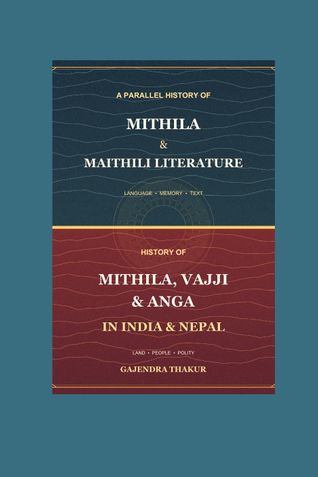
HISTORY OF MITHILA, VAJJI & ANGA in India & Nepal
Review This Book
Write your thoughts about this book.

Currently there are no reviews available for this book.
Be the first one to write a review for the book HISTORY OF MITHILA, VAJJI & ANGA in India & Nepal.
Other Books in History
Perumal Pugazhendhi
Dr. Umesh Chawla

SANDEEP RAGHUNATH PATASKAR

Sarat Chandra Chatterjee