You can access the distribution details by navigating to My Print Books(POD) > Distribution
Add a Review
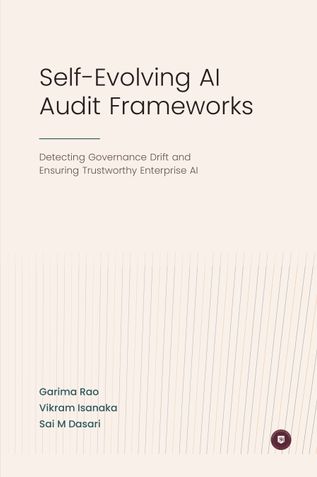
Self-Evolving AI Audit Frameworks
Detecting Governance Drift and Ensuring Trustworthy Enterprise AI
Garima Rao, Vikram Isanaka, Sai M DasariType:
Print Book
Genre: Computers & Internet
Language: English
Price:
₹1,899
+ shipping
This book ships within India only.
Description
Governance that is verified once cannot certify a system that keeps changing after the certificate is issued. The AI systems now running in production retrain on live data, adapt their own weightings, federate learning across organizational boundaries, and in some architectures begin to monitor and correct themselves. The checklist model of oversight breaks on contact with them. This book collects nine technical studies on what replaces it. They cover drift detection and the mechanics of governance drift, adaptive ensemble consensus under a constrained Markov decision process, reproducible explainability audit trails, nonparametric drift auditing for federated learning, causal methods for privacy-preserving compliance verification, evasion-resilience metrics, self-healing security architectures, and meta-adaptive digital twins that anchor their own audit trail on a distributed ledger. Where a result rests on simulation or synthetic data rather than field deployment, the text says so. That candor is what makes the frameworks here worth testing rather than taking on trust.
About the Authors
Book Details
ISBN: 9788118131229
Publisher: SHORAM Editorial Services
Number of Pages: 272
Dimensions: 6"x9"
Interior Pages: Full Color
Binding:
Paperback (Perfect Binding)
Availability:
In Stock (Print on Demand)
Ratings & Reviews
Self-Evolving AI Audit Frameworks
Review This Book
Write your thoughts about this book.

Currently there are no reviews available for this book.
Be the first one to write a review for the book Self-Evolving AI Audit Frameworks.
Other Books in Computers & Internet
Sabin John
Biswanath Parida
MD AZIZUDDIN AAMER