You can access the distribution details by navigating to My Print Books(POD) > Distribution
Add a Review
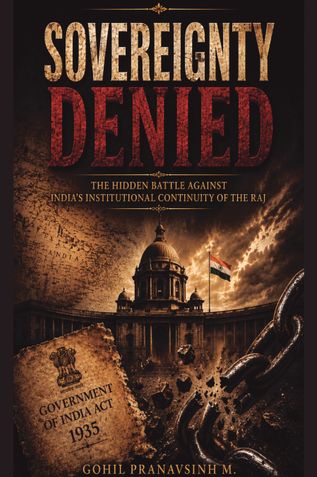
Sovereignty Denied
The Hidden Battle Against India's Institutional Continuity of the Raj.
Gohil Pranavsinh M.Type:
Print Book
Genre: Politics & Society, History
Language: English
Price:
₹450
+ shipping
This book ships within India only.
Description
What if India became politically independent without becoming fully sovereign?
Sovereignty Denied examines the unfinished process of decolonization in post-1947 India. Its central argument is that political independence did not automatically dismantle the institutional, intellectual, and strategic structures inherited from the British Raj. Laws, administrative practices, bureaucratic habits, educational narratives, and approaches to national security continued to shape the Republic long after the Union Jack disappeared.
The book approaches this question from a right-wing, nationalist and security-realist perspective, arguing that a sovereign nation requires more than constitutional independence. It requires the confidence to defend its borders, protect its citizens, preserve its civilizational heritage, and build institutions suited to its own historical circumstances.
Beginning with the final years of British rule, the book revisits the revolutionary and martial traditions associated with Rash Behari Bose, Netaji Subhas Chandra Bose, Veer Savarkar and Bhagat Singh. It challenges the tendency to reduce India's independence struggle to a single narrative centred on constitutional negotiation and non-violence, and examines the role of revolutionary nationalism, military resistance, and the Indian National Army in weakening British confidence in the loyalty of India's armed forces.
The book then turns to the Calcutta killings of 1946, Direct Action Day, Noakhali, Partition and the violence surrounding independence, examining what happens when political morality and appeals for peace are not matched by effective state protection. The controversy surrounding Gopal Patha becomes part of a larger question: when the state fails to protect citizens, who assumes that responsibility?
From there, Sovereignty Denied examines the strategic consequences of post-independence political choices. The 1962 Sino-Indian War is analysed as a warning against strategic complacency, inadequate military preparedness and excessive faith in diplomatic assurances. The book then explores the Kashmir conflict and the 1990 exodus of Kashmiri Hindus, questions surrounding national integration, and the continuing struggle over India's territorial and civilizational identity.
Later chapters examine contemporary controversies surrounding national security, military operations, foreign funding, the Citizenship Amendment Act, the Uniform Civil Code, Article 370, academic institutions, historical memory and the Ram Mandir movement. Throughout, the book asks whether institutions intended to serve a democratic Indian state sometimes continued to operate according to assumptions inherited from the colonial period.
A recurring theme is the tension between moral authority and coercive capability.
The book does not argue that morality, democracy, pluralism or peaceful politics are unnecessary. Its argument is that none of them can substitute for a capable sovereign state. Peace requires deterrence. Liberty requires institutions capable of defending it. Democracy requires territorial integrity. And civilizational confidence requires the freedom to examine one's own history without inherited ideological constraints.
Sovereignty Denied therefore presents decolonization not as a completed event of 1947, but as an unfinished political and intellectual project.
Its ultimate question is simple:
Did India merely inherit the machinery of the Raj—or did it truly become sovereign?
And its answer points toward a different conception of the Indian Republic: secure in its borders, confident in its civilization, economically ambitious, militarily prepared, institutionally independent, and unwilling to confuse political morality with national weakness.
Book Details
Publisher: Gohil Pranavsinh M.
Number of Pages: 444
Dimensions: 6"x9"
Interior Pages: B&W
Binding:
Paperback (Perfect Binding)
Availability:
In Stock (Print on Demand)
Ratings & Reviews
Sovereignty Denied
Review This Book
Write your thoughts about this book.

Currently there are no reviews available for this book.
Be the first one to write a review for the book Sovereignty Denied.
Other Books in Politics & Society, History

Nurul Mostafa Kamal Zafari

Opender Nath Karir

Dibyendu Chakraborty

VIBHAKAR VITTHAL LELE