You can access the distribution details by navigating to My Print Books(POD) > Distribution
Add a Review
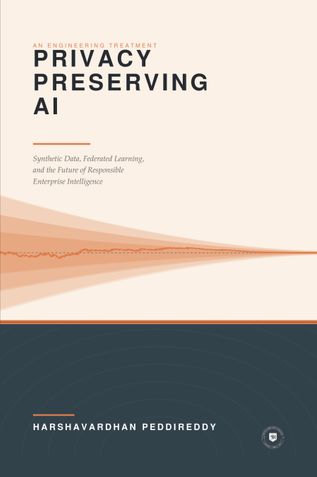
Privacy-Preserving AI
Synthetic Data, Federated Learning, and the Future of Responsible Enterprise Intelligence
Harshavardhan PeddireddyType:
Print Book
Genre: Computers & Internet
Language: English
Price:
₹1,499
+ shipping
This book ships within India only.
Description
A model trained on data nobody can see will still give some of it back. Membership inference, model inversion and gradient reconstruction have each turned a shipped model into a disclosure, and regulators have begun writing the mathematics of leakage into enforceable law. Privacy is now an engineering property of the system, and it belongs to the people who build it.
This book treats the four families of privacy-enhancing technology, synthetic data, federated learning, differential privacy, and the cryptographic and hardware methods, as complementary rather than competing. Each is introduced through a concrete problem before it is formalized, every term is defined where it first appears, and the worked examples reward a reader with a pencil.
Written for data scientists, platform engineers, architects and the technical leaders who answer for what their systems do with personal data. It assumes you have shipped machine learning systems, and no background at all in privacy theory, cryptography or data-protection law.
About the Author
Book Details
ISBN: 9788168699823
Publisher: SHORAM Editorial Services
Number of Pages: 208
Dimensions: 6"x9"
Interior Pages: Full Color
Binding:
Paperback (Perfect Binding)
Availability:
In Stock (Print on Demand)
Ratings & Reviews
Privacy-Preserving AI
Review This Book
Write your thoughts about this book.

Currently there are no reviews available for this book.
Be the first one to write a review for the book Privacy-Preserving AI.
Other Books in Computers & Internet

Ravi Mohan Srivastava

Amit Haval

Dr. Satish Patel, Dr. Rajiv Patel

MD AZIZUDDIN AAMER