You can access the distribution details by navigating to My Print Books(POD) > Distribution
Add a Review
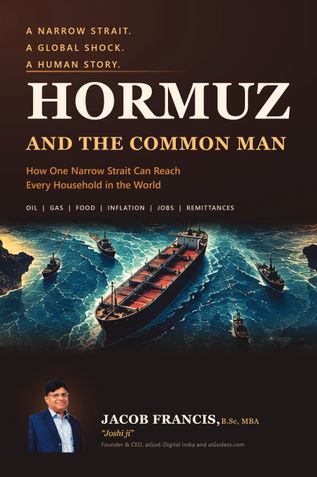
Hormuz and the Common Man
How One Narrow Strait Can Reach Every Household in the World
Jacob FrancisType:
Print Book
Genre: Politics & Society, Business & Economics
Language: English
Price:
₹1,049
+ shipping
This book ships within India only.
Description
A narrow stretch of water can influence the price of petrol, electricity, freight, food, currencies, jobs and the money a migrant worker sends home. Hormuz and the Common Man follows that chain from one of the world's most consequential maritime chokepoints into the daily budget of ordinary households.
The book separates geography from legal control, vessel transits from oil flows, production losses from global supply, and headline price movements from the slower effects on inflation, fertilizer, food, employment, public budgets and remittances. It examines the Gulf states and the major international players, reconstructs the 2026 shock, and asks why the same disruption can be manageable for one country yet devastating for a household with little financial buffer.
Drawing on the IEA, the EIA, UNCTAD, the IMF, the World Bank, the FAO and United Nations treaty and migration sources, every quantity keeps its unit, its period and its denominator, and the household models are presented as frameworks for asking disciplined questions rather than as forecasts.
Inside: the Hormuz Distance Paradox; why a share of seaborne trade is not a share of consumption; the four clocks of a chokepoint shock; the household Real Income Loss identity; a 30-term glossary, a 12-question FAQ and a one-place field book of the numbers.
Written as serious public education rather than investment, military or legal advice, it connects geopolitics to the grocery bill and energy security to the common man.
About the Author
Book Details
Publisher: aigodess.com
Number of Pages: 515
Dimensions: 6.00"x9.00"
Interior Pages: B&W
Binding:
Paperback (Perfect Binding)
Availability:
In Stock (Print on Demand)
Ratings & Reviews
Hormuz and the Common Man
Review This Book
Write your thoughts about this book.

Currently there are no reviews available for this book.
Be the first one to write a review for the book Hormuz and the Common Man.
Other Books in Politics & Society, Business & Economics
Arman S.K.

Dr Kisholoy Roy

Liam M Birkett