You can access the distribution details by navigating to My Print Books(POD) > Distribution
Add a Review
This book ships within India only.
Description
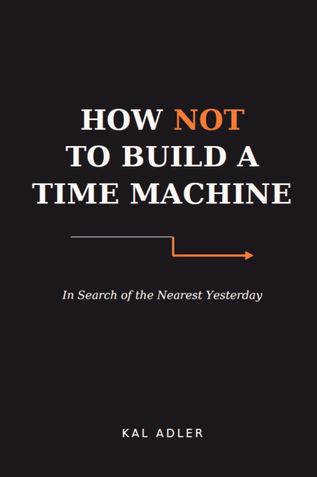
There is a respectable way to begin a book about time travel. It involves Einstein. There is also a less respectable way. It involves a screwdriver.
Treat time travel as an engineering problem and something awkward happens immediately. Before you can ask how to get to 17 June 1985, you have to ask where it is — and yesterday, it turns out, has no address. It isn't far away. It may be nowhere at all.
This is a book about what that question does to everything downstream of it.
It goes through the real physics: the experiments that prove we already travel into the future, the solutions to Einstein's equations that genuinely permit travel into the past, and the reasons almost every physicist believes nature forbids them anyway. It takes the grandfather paradox seriously enough to credit the man who solved it in 1991, and honest enough to admit what his solution costs.
Then it follows the argument sideways. If a date is really a description of a *state*, the destination need not lie behind us. Something sufficiently like it might exist somewhere else — which turns a problem about time into a problem about possibility, search, and, unexpectedly, about what we would owe the people living at the other end.
You will not get a time machine. You will get a parts list, an honest account of which parts are missing, and one idea the author is fairly sure nobody has had before.
About the Author
Book Details
Number of Pages: 175
Dimensions: 6"x9"
Interior Pages: B&W
Binding:
Paperback (Perfect Binding)
Availability:
In Stock (Print on Demand)
Ratings & Reviews
How Not to Build a Time Machine
Review This Book
Write your thoughts about this book.

Currently there are no reviews available for this book.
Be the first one to write a review for the book How Not to Build a Time Machine.
Other Books in Science & Technology
Aravind choudhary
Gulzar Singh
Kirronn Bhandagey, Dr.Priyanka K.Bhandagey (PT)