You can access the distribution details by navigating to My Print Books(POD) > Distribution
Add a Review
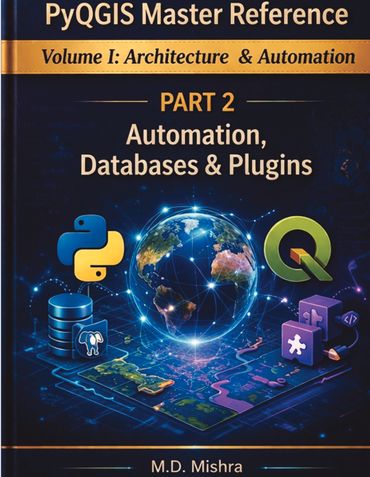
PyQGIS Master Reference Volume I - Architecture & Automation : Part 2 – Automation, Databases & Plugins
M.D. Mishra
Type:
Print Book
Genre: Reference, Information Technology
Language: English
Price:
₹999
+ shipping
Description
Having mastered the core API and the internal mechanics of the QGIS engine in Part 1, you are now prepared to transition from scripting logic to architecting professional-grade spatial systems.
Writing this Master Reference Series was born from a decade of navigating the gap between standard GIS operations and true automation. In my years spent within the geospatial domain, I have seen a consistent pattern: we are excellent at performing spatial analysis, but we often struggle to make that analysis reproducible, scalable and resilient.
For too long, the "GIS Professional" has been defined by their ability to navigate a GUI and execute a sequence of geoprocessing tools. However, as our datasets grow in complexity and our requirements for precision increase, the manual "point-and-click" model reaches a breaking point. We can no longer rely on memory and manual consistency; we must transition into engineering the very logic that drives our analysis. This series is the bridge I wish I had when I first started scripting in QGIS.
About the Author
Book Details
ISBN: 9789358139501
Number of Pages: 554
Dimensions: 7"x9"
Interior Pages: B&W
Binding:
Paperback (Perfect Binding)
Availability:
In Stock (Print on Demand)
Ratings & Reviews
PyQGIS Master Reference Volume I - Architecture & Automation : Part 2 – Automation, Databases & Plugins
Review This Book
Write your thoughts about this book.

Currently there are no reviews available for this book.
Be the first one to write a review for the book PyQGIS Master Reference Volume I - Architecture & Automation : Part 2 – Automation, Databases & Plugins.
Other Books in Reference, Information Technology

Alban Horne

Faizal Noorani

Chintan Mahida

Richa Yamini Goel