You can access the distribution details by navigating to My Print Books(POD) > Distribution
Add a Review
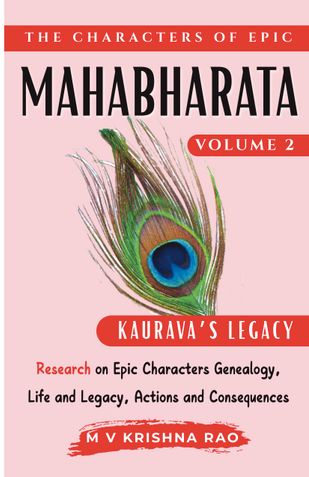
The Characters of Epic Mahabharata Volume 2
Research on Epic characters genealogy, life and legacy, actions and consequences Kauravas Legacy
M V Krishna RaoType:
Print Book
Genre: Religion & Spirituality
Language: English
Price:
₹400
+ shipping
This book ships within India only.
Description
The Kaurava Legacy
Into the Heart of Darkness: Understanding the Epic's Most Complex Characters
The second volume of this comprehensive four-part series delves into the most morally complex territory of the Mahabharata—the lives, motivations, and tragic destinies of the Kaurava faction and its allies. Here, in the shadows cast by Dharma's light, we encounter characters whose complexity defies simple categorisation as heroes or villains, revealing instead the profound psychological insight that makes the Mahabharata humanity's most significant exploration of moral ambiguity.
The Architecture of Antagonism
This volume examines twelve pivotal figures whose choices ignite and sustain the epic's central conflict. Unlike conventional antagonists driven by pure malice, these characters embody the tragedy of noble impulses corrupted by circumstance, blind loyalty, and the inexorable pull of fate toward destruction.
The Blind Court of Hastinapura comes alive through the intertwined destinies of Dhritarashtra, whose physical blindness mirrors his moral blindness; Gandhari, whose self-imposed blindness becomes both supreme sacrifice and tragic limitation; Vidura, the wise counsellor whose dharmic vision cannot prevent catastrophe; and Sanjaya, the divine chronicler who witnesses the war's unfolding with supernatural sight yet remains powerless to alter its course.
The Princes of Destruction emerge through the psychological portraits of Duryodhana, the crown prince whose genuine love for friends coexists with devastating pride; Dussasana, whose actions plumb the depths of adharma; and Vikarna, the lone Kaurava voice of conscience whose moral clarity cannot overcome familial loyalty.
The Architects of Manipulation reveal themselves in Shakuni, the uncle whose chess-like machinations transform personal vengeance into civilizational catastrophe, demonstrating how individual trauma can metastasize into collective destruction.
The Tragedy of Greatness Misdirected
Perhaps no character in all literature embodies the complexity of human nature more than Karna, the abandoned son whose exceptional greatness is matched only by the depth of his tragedy. Born to royalty but raised in poverty, blessed with divine weapons yet cursed by his teacher, capable of surpassing Arjuna yet bound by loyalty to those who accept him, Karna represents the epic's most profound meditation on identity, belonging, and the price of recognition.
Through rigorous textual analysis, this volume examines how Karna's story illuminates the intersection of social justice, personal dignity, and cosmic destiny, revealing why he remains one of the most beloved and debated figures in Indian literature.
Warriors Bound by Conflicting Loyalties
The volume examines Ashwatthama, the immortal warrior whose divine heritage cannot save him from the consequences of his most terrible deed, bearing eternal punishment as a living reminder that even divinely blessed warriors must answer for their choices.
Shalya, the reluctant ally whose divided loyalties reflect the complexity of Dharma, demonstrates how even well-intentioned individuals can become instruments of destruction when caught between competing duties.
Jayadratha, the vengeful king whose death precipitates the war's most catastrophic day, shows how personal humiliation can escalate into conflicts that consume entire civilisations.
Beyond Simple Moral Categories
This volume's most significant achievement lies in its refusal to reduce these complex figures to convenient moral archetypes. Instead, it reveals how the Mahabharata's supposed "villains" often possess qualities that command our admiration—Duryodhana's unwavering friendship, Karna's dignity in the face of social rejection, Gandhari's self-sacrifice, and Ashwatthama's filial devotion.
Through detailed analysis of their genealogies, pivotal life decisions, and textual portrayals across multiple sources, we discover characters whose flaws make them tragically human rather than simply evil. Their stories serve as dark mirrors, reflecting our capacity for self-deception, moral compromise, and the gradual corruption of initially noble impulses.
The Web of Interconnected Destinies
The Kaurava story cannot be understood in isolation. This volume examines the complex web of alliances and conflicts involving the Gandharas, Madras, and other royal families about the central conflict. These relationships reveal that the war in the Mahabharata is not just a family feud; it is a civilizational crisis in which traditional bonds of kinship, loyalty, and Dharma are tested to their limits.
Scholarly Rigour Meets Human Compassion
Drawing exclusively from scriptural sources—the Mahabharata itself and corroborating Puranic literature—this analysis maintains rigorous academic standards while approaching these characters with the compassion necessary to understand their full humanity. Every interpretation is supported by specific textual citations and cross-referenced across multiple authoritative translations.
The methodology combines genealogical research, psychological analysis, and dharmic assessment to create comprehensive portraits that honour both the complexity of the characters and the sophistication of their ancient creators.
A Mirror for Our Times
In an era grappling with questions of loyalty versus justice, tradition versus progress, and individual desire versus the collective good, these ancient characters speak with startling contemporary relevance. Their struggles with pride, belonging, recognition, and moral compromise illuminate eternal human dilemmas while offering profound insights into the consequences of our choices.
For Readers Seeking Depth
This volume challenges readers to move beyond simple moral judgments toward a deeper understanding of human motivation and cosmic justice. Whether encountering these characters for the first time or seeking to deepen existing knowledge, readers will find both accessibility and scholarly depth.
The Kaurava legacy teaches us that understanding our capacity for both good and evil is essential for wisdom. In comprehending how noble individuals can serve ignoble ends, we gain insight into our moral vulnerabilities and the vigilance required to maintain dharmic integrity.
The Continuing Journey
As the second volume in this four-part exploration, this work builds upon the foundational understanding established in Volume 1 while preparing readers for the heroic Yadava narratives (Volume 3) and the dharmic struggles of the Pandavas (Volume 4) that complete this comprehensive character study.
About the Author
Book Details
Publisher: M V Krishna Rao
Number of Pages: 321
Dimensions: 5.50"x8.50"
Interior Pages: B&W
Binding:
Paperback (Perfect Binding)
Availability:
In Stock (Print on Demand)
Ratings & Reviews
The Characters of Epic Mahabharata Volume 2
Review This Book
Write your thoughts about this book.

Currently there are no reviews available for this book.
Be the first one to write a review for the book The Characters of Epic Mahabharata Volume 2.
Other Books in Religion & Spirituality
Dada Bhagwan
Abhishek Srivastava
Dr. Hema Natarajan
KAUSHAL KISHORE