You can access the distribution details by navigating to My Print Books(POD) > Distribution
Add a Review
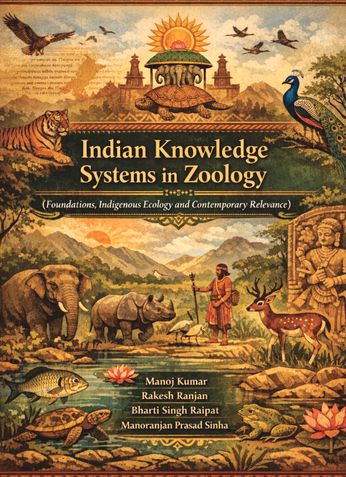
Indian Knowledge Systems in Zoology - Aligned with NEP FYUGP Curriculum
Foundations, Indigenous Ecology and Contemporary Relevance
Manoj Kumar, Rakesh Ranjan, Bharti Singh Raipat, Manoranjan Prasad SinhaDescription
India possesses one of the oldest and richest traditions of knowledge in human civilization. Over
thousands of years, communities across the subcontinent have developed diverse systems of
understanding related to nature, health, agriculture, biodiversity, craftsmanship, and social
organization. These traditions, collectively referred to as Indian Knowledge Systems (IKS), are
rooted in observation, experience, and cultural practices that have been transmitted across generations
through oral traditions, scriptures, community customs, and lived practices.
For centuries, knowledge in India was not confined to written texts alone. It flourished in fields,
forests, rivers, workshops, and village communities. Farmers understood seasonal cycles and soil
health through experience; traditional healers used plants, minerals, and animal-based remedies for
treatment; fishermen developed region-specific fishing methods adapted to local aquatic ecosystems;
artisans mastered complex techniques in metallurgy, textiles, and architecture. Such knowledge
systems reflect a deep ecological understanding and a philosophy that emphasizes harmony between
humans and nature.
In recent decades, however, rapid modernization, industrialization, and globalization have contributed
to the gradual erosion of many traditional practices. Much of the knowledge that once existed within
communities is at risk of being lost as younger generations move away from traditional occupations
and lifestyles. At the same time, there has been growing recognition worldwide that indigenous and
traditional knowledge systems hold immense value in addressing contemporary challenges such as
climate change, biodiversity conservation, sustainable agriculture, and community-based resource
management.
Recognizing this importance, Indian educational policies and academic institutions have increasingly
emphasized the need to integrate Indian Knowledge Systems into higher education curricula. The
National Education Policy (NEP) 2020 strongly advocates the inclusion of indigenous knowledge
traditions in teaching and research, encouraging students to explore the intellectual heritage of India
alongside modern scientific approaches. This book has been developed with this vision in mind.
The primary objective of this book is to introduce students to the concepts, diversity, and contemporary
relevance of Indian Knowledge Systems, particularly in relation to biodiversity, ecological practices,
and traditional livelihood systems. The chapters present various aspects of indigenous knowledge
including traditional ecological practices, ethnozoology, animal-based livelihood systems, folk
veterinary practices, indigenous fisheries, conservation practices rooted in traditional wisdom, ethical
issues related to knowledge documentation, and the integration of traditional knowledge with modern
scientific frameworks.
While preparing this book, special attention has been given to presenting the subject in a manner that is
academically sound yet accessible to undergraduate students. Each chapter attempts to combine
conceptual explanations with real-life examples and case studies from different parts of India. This
approach allows readers to understand not only the theoretical aspects of traditional knowledge but also
its practical applications in everyday life.
The book is also intended to encourage students to engage directly with local knowledge systems
through field-based learning. Many forms of traditional knowledge are best understood through
interaction with local communities, farmers, artisans, healers, and fishermen who continue to practice
these traditions. Documenting such knowledge respectfully and ethically can contribute both to
academic research and to the preservation of valuable cultural heritage.
At the same time, it is important to recognize that traditional knowledge should not be viewed merely
as a relic of the past. Instead, it represents a dynamic body of wisdom that continues to evolve with
changing environmental and social conditions. Integrating traditional insights with modern scientific
research can open new pathways for sustainable development and ecological conservation.
The preparation of this book would not have been possible without the collective contributions of
scholars, researchers, and communities who have worked tirelessly to document and preserve
indigenous knowledge traditions. Their work forms the foundation upon which this text has been
developed. I am also grateful to colleagues, students, and well-wishers whose encouragement and
suggestions have been invaluable during the preparation of this manuscript.
It is hoped that this book will inspire students and readers to appreciate the depth and diversity of
Indian Knowledge Systems and to recognize their relevance in addressing contemporary environmental
and societal challenges. By understanding and respecting these knowledge traditions, we can contribute
to a future that values both scientific innovation and cultural wisdom.
Ultimately, the preservation and revitalization of Indian Knowledge Systems depend on the curiosity,
sensitivity, and commitment of the next generation of scholars and citizens. May this book serve as a
small step in that ongoing journey of learning, discovery, and respect for the knowledge traditions that
have shaped the Indian civilization for millennia.
About the Authors
Book Details
ISBN: 9789357797061
Publisher: Manoj Kumar
Number of Pages: 277
Dimensions: 8.00"x11.00"
Interior Pages: B&W
Binding:
Paperback (Perfect Binding)
Availability:
In Stock (Print on Demand)
Ratings & Reviews
Indian Knowledge Systems in Zoology - Aligned with NEP FYUGP Curriculum
Review This Book
Write your thoughts about this book.

Currently there are no reviews available for this book.
Be the first one to write a review for the book Indian Knowledge Systems in Zoology - Aligned with NEP FYUGP Curriculum.
Other Books in Education & Language

RISHABH KUMAR, PRATISHTHA GIRDHAR, AMISHA SINGLA

M.K. Setia
Mr. Patitpaban Pal, Dr. Soumya Ghosh, Ms. Anusrita ...

Jayanth Munigala, IAS (Retd.)