You can access the distribution details by navigating to My Print Books(POD) > Distribution
Add a Review
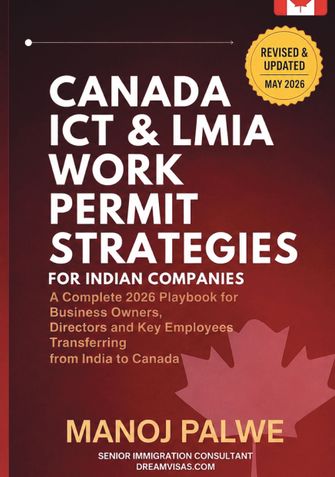
CANADA ICT & LMIA WORK PERMIT STRATEGIES FOR INDIAN COMPANIES
A Complete 2026 Playbook for Business Owners, Directors, and Key Employees Transferring from India to Canada
Manoj Palwe
This book ships within India only.
Description
Canadian work permits for Indian business owners and employees are among the most strategically consequential — and most frequently refused — applications in the entire Canadian immigration system. The Intra-Company Transfer route and the Labour Market Impact Assessment pathway look simple on paper, yet Indian files face an approval gap that no amount of template-downloading has ever closed.
This book closes it.
Written by Manoj Palwe — RCIC R422575, CAPIC Fellow R11592, MIA Examination Qualified, with 25+ years of practice and 10,000+ families served — Canada ICT & LMIA Work Permit Strategies for Indian Companies — 2026 Edition is the definitive strategic playbook for Indian promoters, directors, senior professionals, and HR leaders preparing Canadian work-permit applications.
Across 150+ pages and four structured parts, this book covers:
Part I — The Canadian Work Permit Landscape
The ICT-versus-LMIA decision that every Indian company faces, how Canada's business immigration system actually fits together, and who at IRCC, ESDC, and CBSA actually decides your application.
Part II — Intra-Company Transfer
ICT fundamentals under R205(a) C12, the qualifying parent-subsidiary-branch-affiliate relationship, the Executive vs. Manager vs. Specialized Knowledge categories, building a winning Canadian business case, and the high-stakes Start-Up Canadian Entity ICT pathway.
Part III — LMIA Work Permits
When LMIA is the correct answer, all streams explained (High-Wage, Low-Wage, Global Talent, Owner-Operator), the recruitment and advertising gauntlet, and the Owner-Operator LMIA pathway for Indian business buyers and founders.
Part IV — Execution, Refusals & PR
The Indian-specific documentation playbook (EPF, Form 16, ITR-V, MCA filings, FIRC, and how to reconcile them all), Indian refusal patterns, Procedural Fairness Letter responses, reconsideration and Federal Court judicial review, the two-year plan from work permit to Permanent Residence, and the family dimension covering SOWP, children, and IRPA s.117(9)(d).
Plus 11 appendices covering anonymized case patterns, working templates for the Canadian business plan, LMIA recruitment rationale and ICT cover letter, pre-submission checklists for every application type, a complete glossary, policy interpretation notes on R205(a) and Specialized Knowledge, common GCMS note language decoded, a step-by-step decision framework, sector-specific case patterns for IT services, engineering, pharmaceuticals, manufacturing, healthcare, and academia, sector regulatory notes covering licensure interactions, and an extensive FAQ.
This is not a motivational book. It is not a generic immigration primer. It is a strategic execution manual written by an RCIC who has prepared Indian ICT and LMIA files for 25 years and knows exactly where Indian applicants lose points — and exactly how to recover them.
If you are an Indian promoter evaluating Canadian expansion, a director proposing yourself as the transferee, an HR leader preparing a corporate transfer, or a senior professional whose Indian employer has asked you to relocate to Canada, this book will save you months of wasted time, tens of thousands of dollars in preventable costs, and the serious setback of a refusal that becomes a permanent record on future applications.
Read it before you incorporate the Canadian subsidiary. Read it before you draft the Canadian role description. Read it before you spend anything on an immigration representative.
About the Author
Book Details
Publisher: Manoj Palwe
Number of Pages: 279
Dimensions: 5.83"x8.27"
Interior Pages: Full Color
Binding:
Paperback (Perfect Binding)
Availability:
In Stock (Print on Demand)
Ratings & Reviews
CANADA ICT & LMIA WORK PERMIT STRATEGIES FOR INDIAN COMPANIES
Review This Book
Write your thoughts about this book.

Currently there are no reviews available for this book.
Be the first one to write a review for the book CANADA ICT & LMIA WORK PERMIT STRATEGIES FOR INDIAN COMPANIES.
Other Books in Job & Career

Nandini Devaraya
RUPESH RANJAN
EXAMWAVE EXPERT

Amit Kumar Jha