You can access the distribution details by navigating to My Print Books(POD) > Distribution
Add a Review

Make Money Online for Beginners: 20 Proven Ways ...
Shantanu Dutta
ADAR Visible To AI DIY Manual for Fashion ...
GurukulAI Thought Lab
The Essence of Quality
Suman Sarkar
The Art Of Social Media Marketing
Faizal Noorani
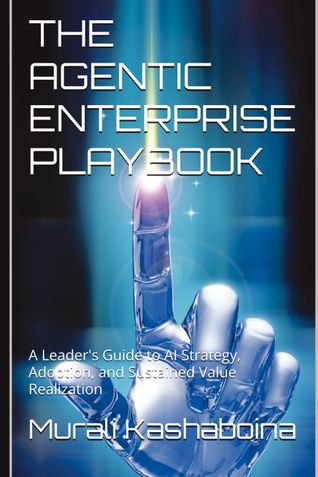
THE AGENTIC ENTERPRISE PLAYBOOK
A Leader's Guide to AI Strategy, Adoption, and Sustained Value Realization
Murali KashaboinaType:
Print Book
Genre: Business & Economics, Information Technology
Language: English
Price:
₹2,499
 Free Shipping
Description
95% of agentic AI projects fail to make it into production. Most enterprise AI initiatives stall at the proof-of-concept stage and never scale. Despite billions invested in data infrastructure, most organizations still cannot answer a basic question: how do we use AI to actually change how we operate, not just to make individual employees marginally more productive?
This playbook is for the leaders who need to fix that.
Written by Murali Kashaboina, PhD, a Chief AI Officer, Chief Data Officer, and forthcoming Wiley author with two decades of leading digital transformations across healthcare, automotive, aviation, and technology, this is a complete, end-to-end leadership playbook for AI adoption. It is not a survey of what AI can do. It is a sequenced, prescriptive guide to what leaders must actually do, in what order, to convert AI ambition into sustained business value.
The book follows eight interlocking decisions every leader must make, organized into three movements.
Establishing Context. Chapter 1 builds the shared mental model: why AI is no longer optional; the three generations of AI (Traditional, Generative, Agentic); the five symbiotic market forces compounding for every business; the seven adoption pitfalls to avoid; and the Context Chasm that separates most enterprises from real AI value. Chapter 2 delivers the most prescriptive content in the book: a ten-step, business-first framework for identifying, scoring, prioritizing, and sequencing AI use cases, along with four mental models, the Lean Canvas business case template, and the use case prioritization matrix.
Building the Foundations. Chapter 3 covers the data foundation that AI depends on, including the use-case-driven data readiness approach, the five-level cloud data governance maturity model, and the critical distinction between data governance and AI governance. Chapter 4 addresses the AI-ready organization: the Chief AI Officer role; when it makes sense, the trade-offs among Center of Excellence, Hub-and-Spoke, and Federated operating models; the RACI for AI delivery; and the executive steering disciplines that prevent AI from drifting.
Executing and Sustaining. Chapter 5 demystifies Agentic AI architecture: nine production-proven patterns (Reason and Act, Chain-of-Agents, Tree-of-Thoughts, Hand-Off, Supervisor-Driven Network, Magentic, Sequential, Hierarchical Network, Semantic Consensus), their trade-offs, and how to select among them. Chapter 6 walks through the eight-phase Agentic AI Development Lifecycle, including context engineering, security as a pipeline rather than a layer, observability, and layer-by-layer evaluation. Chapter 7 shows how to measure values, Chapter 8 emphasizes a disciplined process for vendor selection, and Chapter 9 delves into the unique challenges of change management and how to address them.
A single running case study, a mid-sized health insurance payer losing millions annually due to inadequate data and analytics, traverses every chapter. By the book's end, the reader has watched one organization travel from initial AI ambition through to production deployment of a multi-agent customer service platform.
This book is for: CEOs, COOs, CFOs, Chief AI Officers, Chief Data Officers, Chief Information Officers, Chief Technology Officers, board members, business unit leaders, and senior program leaders responsible for AI transformation outcomes.
What you will leave with: Decision matrices, scoring rubrics, business case templates, RACI charts, evaluation frameworks, and self-assessment tools you can take into your next executive steering meeting on Monday morning.
AI adoption is not a technology program. It is a leadership program that uses technology as its medium. This is the playbook for leading it well.
About the Author
Book Details
ISBN: 9798903304950
Publisher: Independently Published
Number of Pages: 319
Dimensions: 6"x9"
Interior Pages: Full Color
Binding:
Paperback (Perfect Binding)
Availability:
In Stock (Print on Demand)
Ratings & Reviews
THE AGENTIC ENTERPRISE PLAYBOOK
Review This Book
Write your thoughts about this book.
Currently there are no reviews available for this book.
Be the first one to write a review for the book THE AGENTIC ENTERPRISE PLAYBOOK.
Other Books in Business & Economics, Information Technology

Shantanu Dutta
GurukulAI Thought Lab
Suman Sarkar

Faizal Noorani