You can access the distribution details by navigating to My Print Books(POD) > Distribution
Add a Review
Type:
Print Book
Genre: Self-Improvement, Philosophy
Language: English
Price:
₹1,199
+ shipping
Description
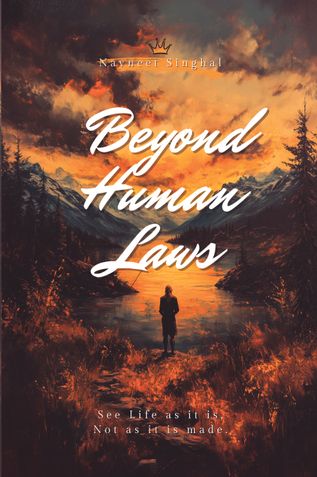
What if many of humanity's biggest problems share the same root cause?
Despite extraordinary progress, humanity continues to face war, pollution, inequality, stress, environmental destruction, religious conflicts, identity-based divisions, and an endless pursuit of success and happiness.
Why?
Among the broad forms of existence on Earth—materials, plants, animals, and humans—only one form consistently creates large-scale problems for itself, for other species, and for the planet.
Humans.
This observation raises a fundamental question:
If humans are considered the most intelligent form of life, why are we also the source of so many problems?
Beyond Human Laws explores this question through a simple approach:
Observe nature directly.
Materials follow their properties.
Plants follow their nature.
Animals follow their instincts.
Yet humans often live through layers of identities, beliefs, traditions, customs, ideologies, and social conditioning inherited from birth.
Most are accepted without question because they are considered normal.
But are they natural?
And what happens when human-made systems drift away from nature's laws?
Through observations, reflections, and thought-provoking questions, this book examines topics such as:
• Success and Happiness
• Human Identity and Conditioning
• Food and Hunger
• Fear and Survival
• Ownership and Money
• Religion and Belief Systems
• Gender and Social Structures
• Race and Human Divisions
• History and Collective Narratives
• Law, Power, and Governance
• Pollution and Environmental Challenges
• Human Systems versus Natural Systems
One of the central ideas explored in this book emerged from observing a simple pattern in nature: life operates through observable laws. When these laws are ignored, beliefs, habits, and systems often replace understanding.
The book introduces the concept of Rarely Thought Questions (RTQs)—questions that challenge commonly accepted assumptions and encourage independent thinking.
Questions such as:
• If nature has no borders, why does humanity remain divided?
• If history is written by the winners, how much of it reflects reality?
• Why do humans seek peace while continuously preparing for war?
• Are we born with identities, or do we inherit them?
• Are we living according to nature's laws—or according to inherited beliefs?
This is not a book of ideology.
It is not a book of dogma.
It does not ask you to accept conclusions.
It invites you to observe, question, and think for yourself.
Because sometimes the most important questions are not the ones we cannot answer.
They are the ones we never think to ask.
Observe. Question. Reflect.
And discover what may exist beyond human laws.
About the Author
Book Details
ISBN: 9789359431017
Publisher: Navneet Singhal
Number of Pages: 239
Dimensions: 6"x9"
Interior Pages: B&W
Binding:
Paperback (Perfect Binding)
Availability:
In Stock (Print on Demand)
Ratings & Reviews
Beyond Human Laws
Review This Book
Write your thoughts about this book.

Currently there are no reviews available for this book.
Be the first one to write a review for the book Beyond Human Laws.
Other Books in Self-Improvement, Philosophy
Chaitanya

ادیبا اظہار
PAWAN KUMAR

ALDIVAN TEIXEIRA TORRES