You can access the distribution details by navigating to My Print Books(POD) > Distribution
Add a Review
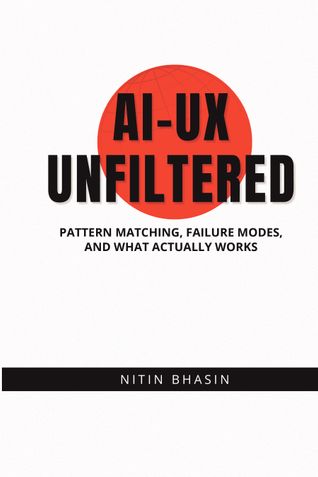
Description
Is your AI-powered product fundamentally broken in ways you can’t quite articulate?
You're not imagining it. There is a critical gap between how AI systems actually work and how most designers have been trained to think about them. You're stuck designing for certainty when the system deals in probabilities, or expecting consistency from systems that learn and drift. The standard UX playbook doesn’t prepare you for this reality.
This book cuts through the hype to show you the path forward.
The uncomfortable truth: AI is not a feature; it's a material.
AI is a probabilistic material with its own unique properties, constraints, and failure modes. If you don’t understand the material, you can’t design well with it. This book gives you the missing mental model you need to design better products, ask better questions, and lead teams through the messy reality of building truly intelligent experiences.
This is not a book about teaching you to code, it’s about teaching you to see.
What You Will Learn (A Comprehensive AI-UX Framework):
This comprehensive guide is divided into four parts, covering every layer of AI-UX design, from the foundational principles to organizational strategy:
I. The Foundations: Pattern Matching, Not Intelligence
What AI Really Is: Understand why most of what we call “AI” is sophisticated pattern matching at scale, not human-like intelligence or comprehension.
The Material's Limits: Explore how AI sees the world, how it learns, and the specific, predictable reasons why AI systems fail in production (Distribution Shift, Context Collapse, Specification Gaming).
Humans vs. Machines: Identify what humans are uniquely good at (judgment, common sense) versus what machines excel at (consistency, scale), and how to design systems that leverage both.
II. Designing Intelligence: The Human–AI Interface
Core Design Patterns: Master the practical, applied patterns that successful AI products use every day.
Expectation Management: Learn to design mental models that help users understand the system without needing an ML degree.
Trust and Control: Build interfaces that deliver transparency without cognitive overload, manage inherent uncertainty, and provide effective human control and overrides.
III. The System Layer: Architecting Intelligence in Production
Systems Thinking: Move beyond single features to understand how real-world AI is built, maintained, and scaled.
Deep Dives: Get focused analysis of core product types, including Search Systems, Recommender Systems, Predictive and Scoring Systems, Conversational Agents, and Generative Interfaces.
IV. Leadership & Governance: The Strategic Layer
Strategic Evaluation: Learn to evaluate AI quality like an expert, asking the right questions about performance and subgroups that ML teams often miss.
Ethical Debt: Understand how early optimization choices compound over time to shape user behavior and organizational risk.
Organizational Design: Discover how to structure teams and processes to build, launch, and maintain AI products reliably.
For Designers, Product Managers, and Leaders:
Stop decorating someone else’s technical decisions and start having the informed conversations that truly drive product success.
If you are a designer shipping features, a product manager defining strategy, or a senior leader managing risk in the age of AI, this book will fundamentally change how you approach your work.
Read it to design with confidence instead of hope.
About the Author
Book Details
Number of Pages: 198
Dimensions: 6"x9"
Interior Pages: B&W
Binding:
Paperback (Perfect Binding)
Availability:
In Stock (Print on Demand)
Ratings & Reviews
AI-UX Unfiltered
Review This Book
Write your thoughts about this book.

Currently there are no reviews available for this book.
Be the first one to write a review for the book AI-UX Unfiltered.
Other Books in Computers & Internet

Vikas Wadhwa

Kshitij N. Bhanu
Abhi Jain
Kushal Das