You can access the distribution details by navigating to My Print Books(POD) > Distribution
Add a Review
Type:
Print Book
Genre: Religion & Spirituality
Language: English
Price:
₹290
+ shipping
This book ships within India only.
Description
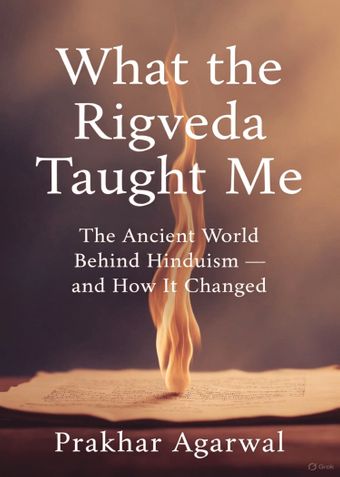
What if the Rigveda does not look like the Hinduism you already know?
I began this journey with a simple assumption: if the Rigveda is the oldest sacred text of Hinduism, then reading it should take me back to the beginning of the religion I already knew. Instead, I found a world that was much stranger—and much more human.
Indra was not yet the figure I knew from later stories. Soma was more than the Moon. Rudra was not yet the fully developed Shiva. Women speak with striking force. The famous fourfold social division appears, but the later caste system cannot simply be read backwards from it. Creation has several competing explanations, and one remarkable hymn even asks whether anyone truly knows how the universe began.
What the Rigveda Taught Me is a personal journey through the gods, rituals, people, society and ideas of the earliest Vedic poetry.
The book explores Agni, Indra and Vritra, Soma, Vak, Purusha, Sarama, Yama, the Nasadiya Sukta and many other voices of the Rigveda. It examines what these hymns reveal about women, social life, kingship, ritual, death and the ancient Vedic imagination.
It also follows the development of ideas about death, rebirth, karma and moksha, asking how later Hindu philosophy emerged from—and sometimes differed from—the earlier Vedic world.
A major part of the journey examines Arya, Dasa and Dasyu, population movement into South Asia, and the relationship between linguistic, archaeological and genetic evidence. The book also questions the temptation to project a simple ancient “Aryan versus Dravidian” division onto the Rigveda.
Throughout, one principle remains central: start with the text.
Separate what the Rigveda explicitly says from what scholars infer. Separate the Rigveda from later Vedic literature, the Upanishads, epics and Puranas. Separate language from ancestry, genes from culture, and ancient identities from modern ones.
This is not a translation of the Rigveda and not a devotional commentary. It is a popular-history book and a personal exploration of an ancient literary world, written with a deliberate distinction between evidence, interpretation and uncertainty.
The Rigveda is neither a perfect ancient golden age nor a primitive caricature. It is a collection of voices—confident, demanding, mysterious, poetic and sometimes deeply uncertain.
What kind of world becomes visible when we allow the Rigveda to speak on its own terms?
About the Author
Book Details
Number of Pages: 171
Dimensions: 5"x7"
Interior Pages: B&W
Binding:
Paperback (Perfect Binding)
Availability:
In Stock (Print on Demand)
Ratings & Reviews
What the Rigveda Taught Me
Review This Book
Write your thoughts about this book.

Currently there are no reviews available for this book.
Be the first one to write a review for the book What the Rigveda Taught Me.
Other Books in Religion & Spirituality
Dhi Prints
Vanakriti
Pratha Sharma