You can access the distribution details by navigating to My Print Books(POD) > Distribution
Add a Review
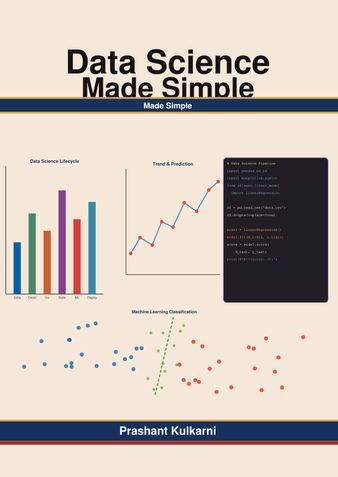
Description
Data Science Made Simple is a calm, clear, and practical guide for readers who want to understand data science from the ground up without being overwhelmed by jargon, shortcuts, or hype. Written in a direct and steady style, the book is designed to help beginners build confidence while also giving working professionals, teachers, analysts, and self-learners a more coherent view of the field as a whole. It treats data science not as a collection of disconnected tools, but as a disciplined way of thinking: observe carefully, ask precise questions, work with evidence, and draw conclusions that can be trusted.
At the heart of the book is a simple but powerful idea: data science is the process of turning raw data into insight and insight into action. To do that well, the reader must learn to combine statistics, computer science, and domain knowledge. The book explains why each of these matters, how they work together, and what can go wrong when one of them is missing. Without statistics, noise can be mistaken for meaning. Without computation, large and messy data cannot be handled effectively. Without domain understanding, the right question may never be asked. That balanced perspective gives the book both clarity and depth.
The structure of the book follows a natural learning path. It begins with the meaning of data science itself, then moves into what data is, where it comes from, and how it is organised. From there, the reader is guided through data understanding, cleaning, preprocessing, and visualisation, before moving on to statistics and machine learning fundamentals. The later chapters bring these ideas together in an end-to-end capstone project, so the reader does not only learn definitions and techniques, but also sees how the full workflow comes together in practice. This makes the book useful both as a textbook and as a working reference.
One of the strengths of the book is its emphasis on reading, practising, and revisiting material in a disciplined way. It encourages the reader to move step by step, to run code examples, to make small changes, to work through exercises, and to return to earlier chapters as understanding deepens. That approach is especially helpful for beginners, because the book is written to remain faithful to the beginner without becoming childish. It also serves experienced readers who want structure, revision, and a dependable explanation of concepts they may already know in fragments.
The book is also strongly grounded in practical application. It includes many real-life examples across healthcare, finance, retail, manufacturing, transportation, government, education, and other fields, showing how data science appears in everyday decision-making and in professional settings. The examples are not decorative; they are meant to help the reader think in terms of problems, data, methods, and outcomes. The later capstone material pushes this further by showing how to define a real-world problem, gather and prepare data, explore it visually, build and evaluate models, interpret results, and present findings clearly. The result is a book that aims to build skill, not just familiarity.
Ethics is treated as part of the craft, not as an optional appendix. The book repeatedly returns to issues such as bias, privacy, transparency, and responsible practice, making the point that data science affects people and should be practiced with care. That concern for judgment is woven into the book’s overall tone. It is modern in subject matter, but traditional in spirit: measured, human, academic, and focused on understanding rather than showmanship. For readers who want a trustworthy beginning in data science, this book offers a steady path forward and a framework they can keep using long after the first reading.
About the Author
Book Details
ISBN: 9789359330433
Number of Pages: 412
Dimensions: A4
Interior Pages: B&W
Binding:
Paperback (Perfect Binding)
Availability:
In Stock (Print on Demand)
Ratings & Reviews
Data Science Made Simple
Review This Book
Write your thoughts about this book.

Currently there are no reviews available for this book.
Be the first one to write a review for the book Data Science Made Simple.
Other Books in Business & Economics
Vinod K Gulati

CA Kishore Reddy
Sriram Gopalan G, Deepak Raj S