You can access the distribution details by navigating to My Print Books(POD) > Distribution
Add a Review
Type:
Print Book
Genre: Literature & Fiction, Drama/Play
Language: English
Price:
₹476
+ shipping
Description
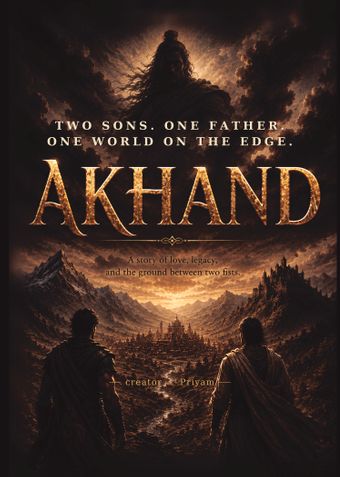
High in the mountain village of Dhartiva, a farmer named Madiva raises two boys at the same hearth on
the same handful of teachings: his own quiet son, Anant, born on an unremarkable night, and a foster son,
Manav, taken in as an infant after his birth parents die in a killing no one in the valley has ever explained.
Madiva loves both boys without reservation — but he does not teach them identically. Watching them
grow, he judges that Anant is ready to be trusted with something dangerous, a deeper store of teaching he
keeps back from Manav, and never tells either son that the choice was ever made.
Anant grows into a man who cannot walk past suffering. He begins walking the lowlands helping
strangers — burying a fever town's dead, mending what a flood has broken — asking nothing in return,
and a following gathers around him that the lowlands come to call the Open Hand. Manav, working the
same lowland roads, discovers a different truth about himself: that he likes the stance without the mercy,
the hitting rather than the being hit. He falls in with an armed company, and builds, tribute-town by
tribute-town, a following of his own — the Closed Fist — bound not by love but by a law that never once
bends, enforced by a single, defining act: the execution of a starving boy for stealing a loaf of bread,
because "a rule that bends once for a good enough reason is not a rule."
Across the decades that follow, both followings grow from bands into full civilizations, armed camps
standing on opposite ends of the same world — and the brothers never once raise a hand against each
other, held by a boyhood love neither can name aloud, even as everything standing between them gets
absorbed into one banner or the other. Anant finds love with Metok, a widow he once helped, and has a
daughter, Adhira. Manav marries Diki, the woman who nursed him after a battlefield wound, and has a
son, Hantha — though he privately carries an old, unspoken longing for Nadira, a warrior-queen he once
failed three times to conquer.
Late in his life, watching his own regional commanders grow more legendary than he is, Manav breaks a
promise he made to himself decades earlier and marches on Nadira's country a final time. The war lasts
eleven months and ends in single combat on her people's last defensible height. Nadira defeats him,
spares his life, and tells him — as he lies wounded in front of her — that he strayed from his father's
actual teaching the moment he mistook it for supremacy; she reveals that her own country has quietly
practiced Madiva's teaching for thirty years, without ever needing a name, a fire, or a clan to hold it.
Manav returns home changed, and never marches on her country again.
Anant, watching his own disciples grow into something closer to a kingdom than a fellowship despite
everything he has tried to build against that outcome, finds himself longing — for the first time aloud, to
an old friend — to walk home to his father and ask whether he has built the thing Madiva actually meant,
or only a gentler version of the same mistake.
Both sons, by the novel's end, privately long to see Madiva one final time. Neither ever manages to say so
where the other can hear it, and the novel leaves unresolved whether either of them ever actually makes
the road home. Both fellowships continue expanding — more by war now than by teaching, though
Anant's people alone still light a fire and tell the old stories in every town they come to hold.
The entire account is framed by Ashwath, a chronicler born generations after these events, who has spent
his life gathering the story in fragments from the oldest surviving lines of both fellowships. He closes the
1
novel on the one thing every person who ever gave him a piece of the story agreed on, however little else
they agreed about: that however widely both sons spread their own names, it was, is, and will be their
father who actually resides in every person's heart — known or unknown to them.
About the Author
Book Details
ISBN: 9789334480931
Number of Pages: 243
Dimensions: 5"x7"
Interior Pages: B&W
Binding:
Paperback (Perfect Binding)
Availability:
In Stock (Print on Demand)
Ratings & Reviews
Akhand
Review This Book
Write your thoughts about this book.

Currently there are no reviews available for this book.
Be the first one to write a review for the book Akhand.
Other Books in Literature & Fiction, Drama/Play

SACHIN TITARMARE
Sumita Choudhury

विक्रम साथी, Students' Academy, Raja Sharma
Saurav Dutt