You can access the distribution details by navigating to My Print Books(POD) > Distribution
Add a Review
Type:
Print Book
Genre: Literature & Fiction, Drama/Play
Language: English
Price:
₹476
+ shipping
Description
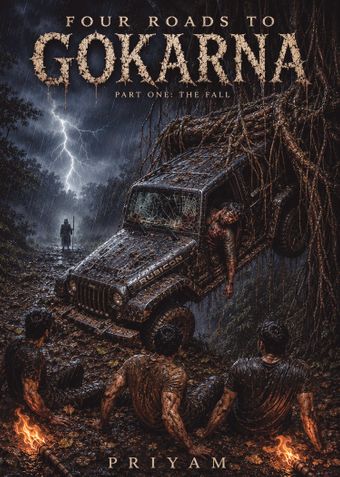
Riyo, Dinu, Abir, and Venkat have been friends since they were eleven years old. Now approaching forty, scattered
across Pune, Mumbai, Bangalore, and Singapore, and each quietly weighed down by a marriage, a career, or a
past he has never fully discussed with the others, the four of them finally commit to a monsoon road trip down the
Konkan coast to Gokarna — four months of planning around a group that has learned, the hard way, how easily
adult life cancels a plan.
The trip itself, narrated in retrospect by Riyo, becomes the occasion for everything the four men have never said out
loud: Dinu’s father’s failing plastics factory and the heartbreak he carried through college before marrying Sayoni;
Abir’s quiet financial anxiety and the fear that, at forty-one, his company sees him as a cost rather than an asset;
Venkat’s abandoned cricket career, and the two relationships — with Mini, a woman from an endangered-dialect
village who later vanished, and with Michelle, a five-year relationship he could never commit to — that taught him
he was capable of loving people he couldn’t hold onto. An odd encounter with an old man at a roadside tea stall,
and something he says that none of them can quite explain, is the last ordinary thing that happens before the rain
and a landslide take the road out from under Riyo’s Jeep.
The Jeep falls into a forest with no name on any map. Riyo, driving, takes the worst of it — a windscreen splinter
to the forehead, hours of unnoticed blood loss, unconsciousness that keeps him out of his own story for most of
the night. Dinu, Abir, and Venkat, shaken but mobile, spend the night keeping watch over him, and keep talking,
because talking is the only thing they have left to do with the fear. What starts as gallows humor about the tiger they
may or may not have heard roar becomes something else once lightning reveals a shape at the treeline that leaves no
footprint, and a scorched, tiger-length carcass turns up in a burned clearing the next morning — evidence, maybe,
that whatever killed it also saved them.
At first light, Riyo briefly regains consciousness — enough to identify his own wound, make one bad joke about
petrol prices, and go quiet again. The three men prepare torches from siphoned petrol and Riyo’s Zippo, agree on
a two-hour, watch-synchronised search in three directions, and split up: Abir downhill toward the plains despite a
bad knee, Venkat back the way they came toward a village he half-remembers passing, and Dinu straight up the cliff
face, a trekking rope — inexplicably packed in Riyo’s Jeep — tied from the wrecked door to his own waist.
None of them find rescue inside the two hours. When they reconverge, Riyo is conscious again, but changed: eyes
open, unblinking, staring at the exact spot where the others saw the impossible figure the night before — six hours
delayed, as if only now catching up to what happened around him. The torch left to guard him, soaked in double
the petrol of the other three, is the only one to have gone out completely dead. Dinu, refusing to let the mystery
cost him more time, turns back up the cliff with Venkat trailing him. Abir stays behind with Riyo — and the torch
that shouldn’t have gone out.
Part One ends here, mid-climb, mid-mystery. Riyo’s retrospective narration confirms, without spoiling how, that
all four men do eventually leave the jungle — but the old man, the vanishing figure, the dead torch, and the woman
Venkat has spent two decades quietly searching for are deliberately, and permanently, left open for Part Two.
About the Author
Book Details
ISBN: 9798189517976
Number of Pages: 235
Dimensions: 5"x7"
Interior Pages: B&W
Binding:
Paperback (Perfect Binding)
Availability:
In Stock (Print on Demand)
Ratings & Reviews
Four Roads to Gokarna
Review This Book
Write your thoughts about this book.

Currently there are no reviews available for this book.
Be the first one to write a review for the book Four Roads to Gokarna.
Other Books in Literature & Fiction, Drama/Play

S.J.Anan

ALISHA

Krishnendu Santra
Sumit Bhadra