You can access the distribution details by navigating to My Print Books(POD) > Distribution
Add a Review
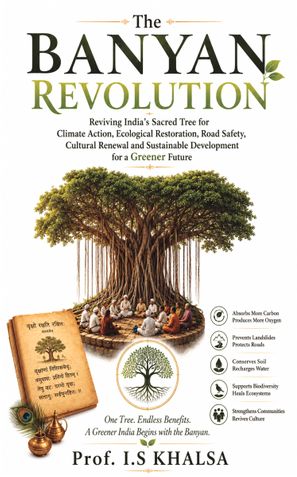
The Banyan Revolution
Reviving India's Sacred Tree for Climate Action, Ecological Restoration, Road Safety, Cultural Renewal and Sustainable Development for a Greener Future
Prof. I.S KhalsaType:
Print Book
Genre: Social Science, Business & Economics
Language: English
Price:
₹263
+ shipping
Description
Some books begin with an idea. Others begin with a question.
This book began with a tree.
For many years, I observed a curious contradiction. India is home to one of the richest ecological and cultural traditions in the world. We celebrate nature through festivals, literature, philosophy, and spirituality. We organize plantation drives every year and speak passionately about climate change, biodiversity conservation, and sustainable development. Yet one of the country's most magnificent native trees—the Banyan (Ficus benghalensis), India's National Tree—has gradually disappeared from many of the places where it once stood at the center of community life.
A century ago, almost every village in India had a mature Banyan tree. It was more than a tree; it was a living institution. Children learned beneath its shade, elders resolved community matters around its trunk, travelers found rest under its vast canopy, and festivals, conversations, and traditions flourished in its presence. It silently connected people with one another and with nature.
Today, many of these trees have vanished from our towns, villages, and cities.
Why did this happen?
More importantly, can we bring them back—not merely as symbols of our past, but as partners in building a more sustainable future?
Those questions became the foundation of this book.
The Banyan Revolution is not simply a book about one tree. It is an exploration of the relationship between civilization and nature. It examines how ancient Indian wisdom, modern environmental science, ecology, forestry, engineering, public policy, and sustainable development can together inspire new approaches to ecological restoration.
Throughout these chapters, readers will travel across diverse fields of knowledge. We will explore the Banyan's place in the Vedas, Upanishads, Puranas, Ayurveda, and India's traditional knowledge systems. We will examine its remarkable biology, ecological importance, role in supporting biodiversity, contribution to carbon sequestration, urban cooling, groundwater conservation, and landscape restoration. We will also investigate innovative ideas for integrating native trees into environmental planning while carefully distinguishing between established scientific evidence and research hypotheses that require future investigation.
One of the guiding principles of this book is that environmental conservation must always be evidence-based. Wherever possible, historical discussions are supported by archaeological findings and historical scholarship. Ecological and climate-related discussions rely on peer-reviewed scientific literature, reports from national and international organizations, and established environmental research. Traditional knowledge is treated with respect, but it is also examined alongside modern scientific understanding so that readers can appreciate both its cultural significance and its practical relevance.
This balanced approach is especially important today. Climate change, biodiversity loss, soil degradation, water scarcity, and environmental pollution are among the greatest challenges facing humanity. These problems cannot be solved by nostalgia alone, nor by technology alone. They require collaboration between science and society, between innovation and tradition, and between policymakers, researchers, educators, engineers, environmentalists, and citizens.
The Banyan tree offers a powerful symbol of this collaboration.
Its roots remind us of our heritage.
Its trunk represents strength and stability.
Its countless branches reflect the diversity of knowledge.
Its expanding canopy symbolizes a future in which human progress and environmental stewardship grow together.
At the same time, this book emphasizes an equally important message: the Banyan is not the answer to every ecological problem. Healthy ecosystems depend on biological diversity, and restoration efforts must always respect local climates, native species, soil conditions, hydrology, and scientific guidance. The Banyan is presented here as a flagship species that can inspire conservation—not as a substitute for ecological planning or biodiversity.
Many of the ideas discussed in these pages, particularly those involving large-scale ecological restoration and the integration of native trees into landscape planning, should be viewed as invitations for further research. Science advances by asking thoughtful questions, testing new hypotheses, evaluating evidence, and refining ideas through collaboration. It is my hope that this book encourages such interdisciplinary dialogue among botanists, foresters, ecologists, engineers, geologists, climate scientists, urban planners, policymakers, educators, and students.
If this book inspires a researcher to undertake a new study, a teacher to introduce environmental stewardship into the classroom, a policymaker to strengthen native tree conservation, a student to protect a heritage tree, or a citizen to plant and care for an indigenous species in an appropriate location, then it will have achieved its purpose.
The Banyan has stood beside Indian civilization for centuries without demanding recognition. It has given shade, shelter, stability, and life to countless generations. Perhaps it is time that we return a small part of that gift—not simply by admiring this extraordinary tree, but by restoring the landscapes, values, and ecological relationships that allowed it to flourish.
The future of India will not be secured by economic growth alone.
It will also depend upon healthy forests, resilient ecosystems, clean air, fertile soil, abundant water, thriving biodiversity, and a society that understands that development and conservation are partners rather than competitors.
May this book contribute, in its own small way, to that vision.
About the Author
Book Details
Publisher: The Enlightenment
Number of Pages: 147
Dimensions: 5"x8"
Interior Pages: B&W
Binding:
Paperback (Perfect Binding)
Availability:
In Stock (Print on Demand)
Ratings & Reviews
The Banyan Revolution
Review This Book
Write your thoughts about this book.

Currently there are no reviews available for this book.
Be the first one to write a review for the book The Banyan Revolution.
Other Books in Social Science, Business & Economics

SM Abbas Rizvi

Prince Pipalea

Zameer Ahmed Shaikh

Amit Kumar Jha