You can access the distribution details by navigating to My Print Books(POD) > Distribution
Add a Review
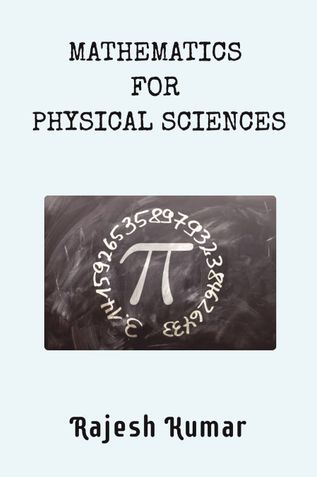
MATHEMATICS FOR PHYSICAL SCIENCES
A First-Principles Bridge from School Mathematics to University Physics
RAJESH KUMARType:
Print Book
Genre: Mathematics, Science & Technology
Language: English
Price:
₹570
+ shipping
Description
Physics becomes difficult when its mathematical language has never been made clear. Many students reach university able to repeat formulas but unable to explain what a function represents, why a derivative measures local change, how an integral accumulates a physical quantity, or how vectors, matrices, and differential equations describe real systems.
Mathematics for Physical Sciences is written to repair that gap. It begins with the meaning of number, measurement, units, fractions, algebra, graphs, geometry, and trigonometry, then advances step by step through calculus, series, vectors, multivariable analysis, linear algebra, differential equations, Fourier methods, probability, uncertainty, and numerical computation. No essential idea is treated as obvious merely because it appeared in school.
The book connects every mathematical structure to a physical interpretation. Original TikZ illustrations make relations visible; derivations show where formulas come from; and 220 solved numerical problems demonstrate how concepts become methods. A further 220 exercises develop independent fluency across the full range of each chapter.
Designed for B.Sc. freshers, bridge-course students, and independent learners, this is both a patient beginning and a rigorous foundation for later study in physics and allied sciences.
About the Author
Book Details
Publisher: RAJESH KUMAR
Number of Pages: 330
Dimensions: 6"x9"
Interior Pages: B&W
Binding:
Paperback (Perfect Binding)
Availability:
In Stock (Print on Demand)
Ratings & Reviews
MATHEMATICS FOR PHYSICAL SCIENCES
Review This Book
Write your thoughts about this book.

Currently there are no reviews available for this book.
Be the first one to write a review for the book MATHEMATICS FOR PHYSICAL SCIENCES.
Other Books in Mathematics, Science & Technology

Sarthak Shripad Oka


Junaid Jazib