You can access the distribution details by navigating to My Print Books(POD) > Distribution
Add a Review
Type:
Print Book
Genre: Philosophy, Religion & Spirituality
Language: English
Price:
₹1,500
+ shipping
Description
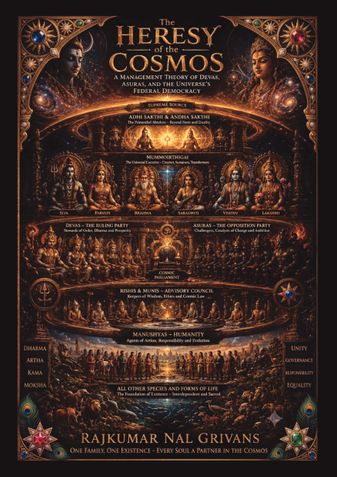
The Heresy of Cosmos: Principles of Celestial ManagementBy Rajkumar Nal GrivansOverviewWhat if the timeless war between Devas and Asuras was never a struggle between good and evil, but a perpetual battle between a ruling establishment and its political opposition? What if the universe isn't a mystical realm, but a tightly managed corporate structure running on strict administrative protocols?In The Heresy of Cosmos, Rajkumar Nal Grivans presents a groundbreaking re-examination of Indian mythology, Vedic etymology, and Puranic narratives. Stripping away centuries of moralistic storytelling, this provocative work reinterprets celestial dynamics through the cold, pragmatic lens of political science, public administration, and modern corporate governance. Key Highlights & ThemesThe Executive Triad: Reinterprets the Trimurti not merely as gods, but as functional administrative officers—Brahma as the Project Manager/Architect, Vishnu as the Chief Operations Officer maintaining system balance, and Shiva as the Restructuring Officer overseeing necessary depreciation and lifecycle resets. The Federal Illusion: Re-examines the Deva-Asura conflict through the lens of political cycles, framing Devas as the entrenched Ruling Party defending status quo privileges, and Asuras as the marginalized Opposition seeking systemic redistribution. The Linguistic Heist: Traces the historical shift in Vedic etymology and Dravidian Siddhar traditions, showing how technical administrative terms were gradually transformed into moralistic dogma and myth. Corporate Cosmos: Draws striking parallels between ancient celestial hierarchies and modern boardroom politics, executive insecurity, bureaucratic inertia, and organizational survival. About the BookThe Heresy of Cosmos challenges readers to look beyond devotion and dogma to discover a sophisticated blueprint of governance hidden in plain sight. Bridging comparative philosophy, ancient history, and organizational theory, Grivans offers an intellectually stimulating read for thinkers, managers, mythologists, and political enthusiasts alike.
About the Author
Book Details
Number of Pages: 197
Dimensions: A5
Interior Pages: B&W
Binding:
Paperback (Perfect Binding)
Availability:
In Stock (Print on Demand)
Ratings & Reviews
THE HERESY OF COSMOS
Review This Book
Write your thoughts about this book.

Currently there are no reviews available for this book.
Be the first one to write a review for the book THE HERESY OF COSMOS.
Other Books in Philosophy, Religion & Spirituality

Ravi Gupta

Shrigopal Agrawal

हिमांशुराय रावल हक़ीर

Utkarsh Walia