You can access the distribution details by navigating to My Print Books(POD) > Distribution
Add a Review
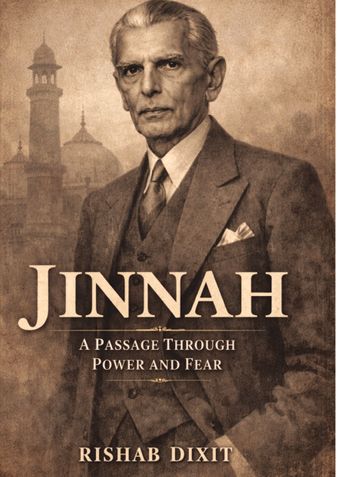
Jinnah: A Passage Through Power and Fear
A rational look at Jinnah and the choices that divided a nation.
Rishab Dixit
This book ships within India only.
Description
Muhammad Ali Jinnah is often remembered in extremes: either as a flawless founder or as the sole villain of Partition. Both views simplify a complex reality.
Focusing on the period between 1900 and 1950, it examines Jinnah not as a symbol, but as a decision-maker. It traces his transformation from a constitutional nationalist and advocate of Hindu-Muslim unity to the central figure behind the demand for Pakistan.
Through a rational, evidence-based lens, the book explores:
1) Whether the Two-Nation Theory was a belief or a bargaining strategy
2) How the 1937 elections altered political realities
3) The moral and political implications of Direct Action Day
4) The failure of the Cabinet Mission, the last real alternative to Partition
5) And why questioning Jinnah today is often seen as betrayal
This is not a book of worship or condemnation. It is a book about choices, context, and consequences.
Written for readers who value critical thinking over inherited narratives, this work argues that understanding history does not weaken nations. It matures them.
Because history deserves honesty, not loyalty.
About the Author
Book Details
Publisher: Self-Published
Number of Pages: 154
Dimensions: 5.83"x8.27"
Interior Pages: B&W
Binding:
Paperback (Perfect Binding)
Availability:
In Stock (Print on Demand)
Ratings & Reviews
Jinnah: A Passage Through Power and Fear
Review This Book
Write your thoughts about this book.

Currently there are no reviews available for this book.
Be the first one to write a review for the book Jinnah: A Passage Through Power and Fear.
Other Books in History

Shaukat Ali

K. N. Sivaraja Pillai
Rajnikant Puranik
Seth Govinddas