You can access the distribution details by navigating to My Print Books(POD) > Distribution
Add a Review
This book ships within India only.
Description
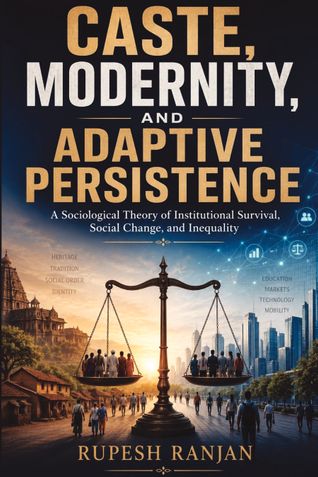
Why do social institutions survive even when societies undergo profound transformation?
Caste, Modernity, and Adaptive Persistence offers a bold and original answer to one of sociology’s most enduring questions. While modernization, urbanization, education, globalization, democratic politics, and digital technologies have transformed contemporary India, caste continues to influence social relationships, opportunities, identities, and inequalities in complex and evolving ways.
Drawing upon classical sociological thought, institutional theory, political economy, globalization studies, and contemporary research on social stratification, this book develops Adaptive Persistence Theory (APT)—a new theoretical framework explaining how institutions endure by adapting their mechanisms while preserving core elements of identity and function.
Using caste as its primary case study, the book explores the dynamic relationship between continuity and change, demonstrating how social institutions evolve across shifting historical, economic, political, and technological environments without disappearing entirely. The analysis moves beyond traditional explanations of institutional persistence and proposes a broader model applicable to religion, family systems, education, markets, organizations, and digital social structures.
Book Details
Number of Pages: 227
Dimensions: 6.00"x9.00"
Interior Pages: B&W
Binding:
Paperback (Perfect Binding)
Availability:
In Stock (Print on Demand)
Ratings & Reviews
CASTE, MODERNITY, AND ADAPTIVE PERSISTENCE
Review This Book
Write your thoughts about this book.

Currently there are no reviews available for this book.
Be the first one to write a review for the book CASTE, MODERNITY, AND ADAPTIVE PERSISTENCE.
Other Books in Politics & Society

Y. Akhilesh

Seyed E. Zamani

Ankit Vats
Bankim Chandra Chatterji