You can access the distribution details by navigating to My Print Books(POD) > Distribution
Add a Review
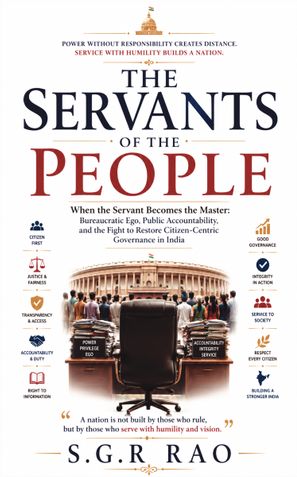
The Servants of the People
When the Servant Becomes the Master: Bureaucratic Ego, Public Accountability, and the Fight to Restore Citizen-Centric Governance in India
S.G.R RAOType:
Print Book
Genre: Social Science, Politics & Society
Language: English
Price:
₹235
+ shipping
Description
Every nation is ultimately judged not only by the strength of its laws, institutions, and economy but also by the relationship between its citizens and those who are entrusted with public responsibility. A government exists because people create it, support it, and place their trust in it. The individuals working within government institutions are therefore not owners of power but guardians of public trust.
The words “public servant” carry a profound meaning. They represent a simple democratic principle: authority is given by the people and must always be exercised for the welfare of the people. Yet, across societies and throughout history, there has always been a challenge in ensuring that those who hold administrative power continue to remember the purpose behind that power.
The Servants of the People explores one of the most important conversations about governance in modern India—the changing relationship between citizens and public institutions.
This book does not attempt to criticize government employees as a group. Such a conclusion would be unfair and inaccurate. India has produced countless dedicated public servants who have demonstrated honesty, courage, innovation, and extraordinary commitment toward improving people's lives. From administrators transforming neglected districts to teachers working in difficult conditions, from healthcare workers serving remote communities to police officers protecting vulnerable citizens, thousands of government employees continue to strengthen the nation every day.
However, a mature democracy must also have the courage to examine its weaknesses.
When citizens experience unnecessary delays, disrespectful behavior, lack of transparency, corruption, or administrative indifference, the issue is not merely an individual inconvenience. It affects public trust, economic growth, social harmony, and confidence in democratic institutions.
Behind every government file, there is a human story.
A delayed pension may represent an elderly person's struggle for survival.
A delayed certificate may affect a student's future.
A delayed business approval may prevent employment opportunities.
A neglected complaint may leave a victim feeling powerless.
Administration is therefore not only about procedures and paperwork.
It is about people.
The central question of this book is not whether government employees possess authority. They do. The deeper question is whether that authority is being used according to the true spirit of public service.
How does a servant become distant from the people he or she is meant to serve?
Why does a position created to help citizens sometimes become a symbol of control?
Why do many young Indians continue to view government employment as the ultimate achievement rather than entrepreneurship, innovation, and job creation?
What reforms are required to rebuild respect between citizens and government institutions?
To understand these questions, this book examines the issue through multiple dimensions—historical, psychological, constitutional, educational, economic, and administrative.
The historical journey reveals how colonial administrative traditions influenced India's bureaucratic culture and why changing institutional habits has remained a complex challenge after independence. The psychological analysis explores how social prestige, job security, and family expectations transformed government employment into one of India's biggest career dreams. The economic perspective examines how excessive focus on government jobs can influence entrepreneurship, innovation, and employment creation.
The constitutional perspective reminds us that democratic authority originates from citizens. The phrase “We, the People of India” represents the foundation of the Republic. Public institutions exist not above society but because society has created them.
The administrative perspective explores both failures and successes. It examines documented cases where citizens faced difficulties while accessing legitimate services, but it also highlights inspiring public servants who proved that empathy, professionalism, and accountability can transform governance.
A country cannot progress by weakening its institutions.
It progresses by improving them.
The solution is not to create hostility between citizens and government employees. The solution is to rebuild a relationship based on mutual respect.
Citizens must understand their rights and responsibilities.
Government employees must understand that public office is a responsibility, not a privilege of superiority.
Educational institutions must encourage young people not only to seek employment but also to create opportunities.
Families must broaden their definition of success.
Civil society must encourage accountability while recognizing genuine public service.
Technology must improve accessibility while preserving human compassion.
India's journey toward becoming a developed nation requires more than economic growth. It requires institutions that citizens trust, officials who act with integrity, and a society where service is valued above status.
The future of governance depends upon a simple transformation in mindset:
From authority to responsibility.
From control to service.
From bureaucracy to partnership.
From public power to public purpose.
The greatest public servants in history were not remembered because of the positions they held. They were remembered because of the lives they improved.
A government office is not merely a workplace.
It is a place where the promises of democracy become reality.
A file is not merely paper.
It may represent someone's future.
A citizen is not merely an applicant.
He or she is the reason the institution exists.
This book is an invitation to rethink the meaning of public service. It is a call for stronger accountability, better institutions, ethical leadership, and a renewed understanding that democracy succeeds when those in power always remember whom they serve.
Because the true measure of a public servant is not the authority they possess.
It is the trust they protect.
And when the servants of the people truly understand their purpose, they do not merely improve government.
They help build a stronger nation.
About the Author
Book Details
Publisher: The Enlightenment
Number of Pages: 122
Dimensions: 5"x8"
Interior Pages: B&W
Binding:
Paperback (Perfect Binding)
Availability:
In Stock (Print on Demand)
Ratings & Reviews
The Servants of the People
Review This Book
Write your thoughts about this book.

Currently there are no reviews available for this book.
Be the first one to write a review for the book The Servants of the People.
Other Books in Social Science, Politics & Society

KAAL BHAIRAV

Amit Kumar Manocha

Patrick Scheffer