You can access the distribution details by navigating to My Print Books(POD) > Distribution
Add a Review
Description
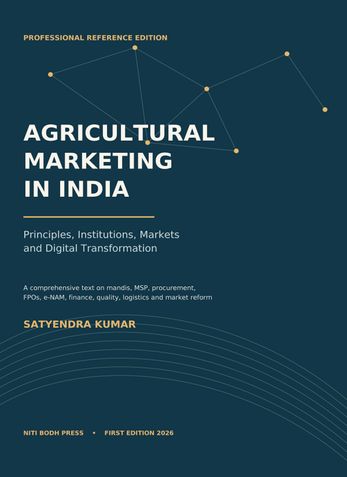
Agricultural Marketing in India: Principles, Institutions, Markets and Digital Transformation is a comprehensive guide to the economic, institutional and operational foundations of agricultural marketing in India.
The book explains how agricultural produce moves from the farm to the final buyer and why the farmer’s economic outcome depends on much more than the market price alone. It examines the complete chain of marketing functions, including aggregation, transportation, storage, grading, assaying, financing, price discovery, payment, logistics, processing and risk management.
A central theme of the book is that agricultural marketing should be judged by farmer net realisation, not merely by the headline price. A higher quoted price may not necessarily lead to a better return once transport, handling, storage, quality deductions, financing costs, payment delays and other transaction expenses are taken into account. The book therefore presents agricultural marketing as an integrated economic system rather than a simple act of buying and selling.
Across 29 chapters, the book covers the evolution of agricultural marketing in India, agricultural market structures, demand and supply, price formation, marketing costs and margins, competition, farmer bargaining power, regulated markets and the APMC system. It explains how an agricultural mandi functions and examines the institutional and regulatory architecture that supports market transactions.
The book also discusses Minimum Support Price, government procurement, buffer stocks and the Public Distribution System; warehousing and warehouse receipts; cold storage; logistics and supply chains; processing and value addition; FPOs and cooperatives; agricultural finance; grading, quality certification, assaying and AGMARK; contract farming; direct marketing; commodity exchanges; futures markets; agricultural exports and international trade.
A substantial part of the book is devoted to the digital transformation of agricultural marketing. It examines e-NAM, electronic price discovery, market information systems, digital payments, traceability, data-based monitoring and the growing role of technology in market regulation and administration. At the same time, it emphasizes that digitalisation cannot replace physical infrastructure, quality assurance, logistics, competition or reliable payment systems.
The book also analyses the marketing characteristics of major agricultural commodities, compares state-level agricultural marketing systems and reforms, and includes a dedicated discussion of the agricultural marketing system of Uttar Pradesh.
Written by Satyendra Kumar, an officer in the State Agricultural Produce Markets Board, Uttar Pradesh, with over 20 years of professional experience in agricultural-market administration, regulation and reform, the book combines institutional understanding with practical field experience. The author has also served as the State Nodal Officer for e-NAM in Uttar Pradesh.
This book is intended for students of agricultural economics and agribusiness, agricultural marketing professionals, mandi officials, policymakers, researchers, FPOs, traders, administrators and readers seeking a practical and structured understanding of India’s agricultural marketing system.
The book ultimately argues that the future of agricultural marketing lies in the integration of competitive markets, quality systems, storage, finance, logistics, digital platforms, payments, traceability and market intelligence—with the farmer’s net realisation remaining at the centre of reform.
About the Author
Book Details
ISBN: 9789334518313
Publisher: Niti Bodh Press
Number of Pages: 200
Dimensions: 8"x11"
Interior Pages: B&W
Binding:
Paperback (Perfect Binding)
Availability:
In Stock (Print on Demand)
Ratings & Reviews
Agriculture Marketing in India
Review This Book
Write your thoughts about this book.

Currently there are no reviews available for this book.
Be the first one to write a review for the book Agriculture Marketing in India.
Other Books in Reference

Noel Lorenz, Anuradha Chakraborty

(Prof.) Dr. B. K. Sarkar, Prof. (Dr.) Reena ...

Ameya Nisal

Dr. Naresh Kumar Batish