You can access the distribution details by navigating to My Print Books(POD) > Distribution
Add a Review
Description
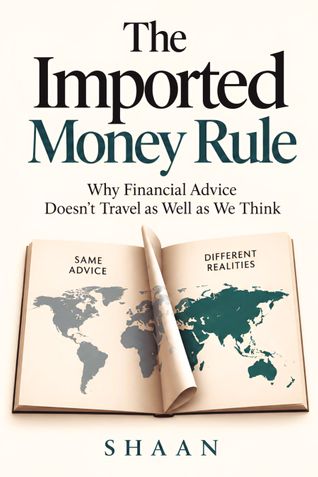
What if the money rules you’ve been following were never designed for your economy?
“Spend no more than 30% of your income on housing.”
“Put 20% of your income into savings.”
“Use the 20/4/10 rule when buying a car.”
“Own a certain percentage of gold.”
“Hold your age in bonds.”
“Withdraw 4% in retirement.”
These rules are everywhere. They are simple, memorable, and often presented as if they were universal laws of personal finance.
But money does not exist in a vacuum.
A financial rule can change meaning when you change the country, city, tax system, housing market, interest rates, social safety net, retirement system, or family structure behind it.
The Imported Money Rule asks a deceptively simple question:
Who was this rule made for?
Beginning with a question the author first encountered as a teenager—why did so much popular financial advice feel disconnected from the prices, incomes, and realities around him?—this book examines the assumptions hiding behind familiar money rules.
From the 30% housing rule and the 20/4/10 car rule to the 50/30/20 budget, 20% savings rule, 4% retirement rule, gold and crypto allocations, FIRE, and the idea that a house is automatically a great investment, the book traces where these ideas come from and explores how their meaning changes across different financial systems.
You’ll see how the same percentage can look very different in:
India and the United States
Singapore and Mumbai
Germany and New Zealand
Japan and the United Kingdom
Canada, Australia, Brazil, Korea, and other markets
The goal is not to reject financial rules—or to replace them with another set of rigid numbers.
It is to learn how to translate them.
Because the useful question is rarely:
“What percentage should I follow?”
It is:
“What assumptions produced this percentage, and do those assumptions describe my life?”
Inside, you’ll learn how to:
Separate a useful financial principle from the specific rule built around it
Understand the economic and historical context behind popular money advice
Recognize when percentages hide important differences
Compare financial rules across countries and cities
Account for taxes, housing markets, pensions, family support, debt, and social safety nets
Think differently about renting, buying, cars, investing, insurance, education, and retirement
Test whether an imported rule actually fits your income and circumstances
Recalculate financial advice without pretending there is one perfect number
Build your own framework for judging financial advice
The Imported Money Rule is not a book about finding the perfect percentage.
It is a book about learning what the percentage is actually saying.
Listen to the principle. Question the assumptions. Recalculate the rule for your economy.
About the Author
Book Details
Number of Pages: 240
Dimensions: 6.00"x9.00"
Interior Pages: B&W
Binding:
Paperback (Perfect Binding)
Availability:
In Stock (Print on Demand)
Ratings & Reviews
The Imported Money Rule
Review This Book
Write your thoughts about this book.

Currently there are no reviews available for this book.
Be the first one to write a review for the book The Imported Money Rule.
Other Books in Business & Economics

Kunal Narayan Uniyal

Vishwadeep Kamble

Satvinder Singh Ghotra

Kunal Gaurav