You can access the distribution details by navigating to My Print Books(POD) > Distribution
Add a Review
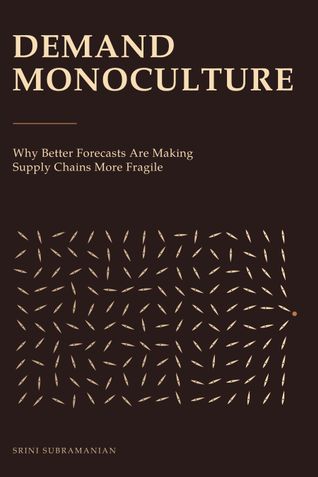
Description
What if better forecasting is making supply chains less stable, not more?
For decades, supply chain theory has assumed that independent buyers make independent decisions. Better forecasts, faster information, and greater visibility were therefore expected to produce more efficient, more resilient markets.
This book argues that one of those assumptions is quietly failing.
Demand Monoculture introduces a new framework for understanding how shared public signals can synchronise the behaviour of otherwise independent organisations. When every planner observes the same information and responds rationally to it, individually correct decisions can combine into collectively damaging outcomes. The result is not panic, irrationality, or poor management, but a structural mechanism that amplifies shortages, prolongs disruption, and creates fragile supply chains even when every participant acts competently.
Using the semiconductor crisis as its central case, the book develops the mechanism step by step, explains why conventional explanations remain incomplete, and introduces new ways to measure synchronised demand behaviour. It distinguishes clearly between evidence, inference and predictions, provides reproducible analytical methods, and identifies the conditions under which its claims can be tested or disproved.
Rather than offering another management framework or forecasting methodology, Demand Monoculture proposes a different way of thinking about modern supply chains: not as collections of independent firms, but as populations of decision-makers increasingly coupled through shared information.
Written for supply chain professionals, operations leaders, researchers, economists, policymakers and anyone interested in how intelligent systems influence collective behaviour, this book challenges established assumptions and presents a framework intended to stimulate empirical research as much as practical discussion.
If its central argument is correct, one of the foundations of modern supply chain thinking will require re-examination. If it is wrong, the book states explicitly how future evidence can prove it so. That commitment to falsifiability is part of the argument itself.
About the Author
Book Details
Publisher: XSYDA Technologies Private Limited
Number of Pages: 248
Dimensions: 6"x9"
Interior Pages: B&W
Binding:
Paperback (Perfect Binding)
Availability:
In Stock (Print on Demand)
Ratings & Reviews
Demand Monoculture
Review This Book
Write your thoughts about this book.

Currently there are no reviews available for this book.
Be the first one to write a review for the book Demand Monoculture.
Other Books in Business & Economics

Siddharth Peeyush

Ranjot Singh Chahal

Srinivasa Rao Medaboina

Bright Mills