You can access the distribution details by navigating to My Print Books(POD) > Distribution
Add a Review

SANITATION AND WASTE MANAGEMENT
RUPESH RANJAN
Thinking in Systems, Not Code
Ankit Anurag Naik
Plastic Processing Operator
Manoj Dole
Tavera Car Care at Home
Ashwini Dole
This book ships within India only.
 Free Shipping
Description
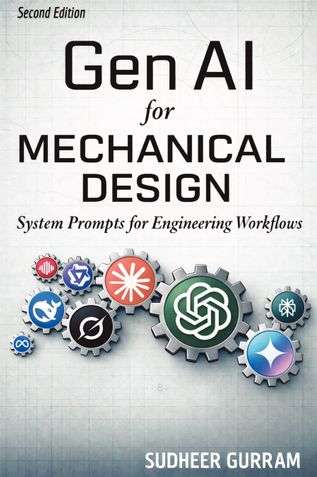
Gen AI for Mechanical Design Engineers
Turn AI into a Practical Engineering Assistant for Real Design Work
Most engineers experimenting with AI hit the same wall:
You try a few prompts… get mixed results… and eventually stop using it for serious work.
This book fixes that.
Instead of random prompts, you’ll learn how to build reliable AI assistants that actually support your day-to-day mechanical design workflow.
What This Book Helps You Do
Use AI to:
- troubleshoot design issues faster
- verify calculations before they become costly mistakes
- shortlist materials without digging through endless datasheets
- explore product concepts during early design stages
- scan patents and research without spending hours reading
- find components and suppliers more efficiently
Think of it as building your own team of AI assistants — each trained for a specific engineering task.
What’s Inside
At the core of this book are System Prompts — the key to getting consistent, high-quality outputs from tools like ChatGPT and other LLMs.
You’ll learn:
- what system prompts are and why they matter
- how to structure them for reliable results
- how to choose the right model for each task
- how to tune outputs for accuracy and usefulness
20 Practical AI Assistants for Mechanical Engineers
The book includes ~20 real-world use cases, each focused on new product development workflows.
You’ll build assistants like:
- Instructor → explains concepts clearly (Feynman-style)
- Ideator → generates next-gen product concepts
- Troubleshooter → helps debug design problems
- FactChecker → validates technical claims
- Benchmarker → compares competitor products
- Patent Pal → performs quick prior-art checks
- Scholar → summarizes research papers
- Part Scout → finds components and suppliers
- Material Finder → recommends suitable materials
- Professor Calc → checks hand calculations
- Tolerator → analyzes tolerances
- Sketch-It → converts ideas into visual concepts
- Render Pro → supports visual presentation work
- Decker → helps with design presentations
- Write Master → improves reports and documentation
- Code Smith → generates scripts (Python, VBA, TCL)
- Project Genie → supports project planning workflows
How It’s Structured:
No long theory. No fluff.
Each use case is capped to ~2 pages and includes:
✔ a ready-to-use system prompt
✔ clear explanation of how it works
✔ ideas to customize it for your workflow
You can start applying these immediately.
What Makes This Different:
This isn’t another “learn AI” book.
It’s a practical playbook for mechanical engineers who want to:
save time on repetitive work
improve decision-making
reduce errors in design
integrate AI into daily workflows
The Real Goal:
This book doesn’t just give you prompts.
It teaches you how to think in systems — so you can build your own AI assistants for any engineering task.
Teach a man to fish… but with AI.
Who This Is For:
Mechanical design engineers
Product development engineers
Engineering students preparing for real-world work
By the End:
You won’t just “know prompts.”
You’ll have a working set of AI-powered engineering assistants you can rely on.
If you’ve tried using AI but haven’t been able to make it consistently useful in your engineering work— this is where it starts to click.
About the Author
Book Details
ISBN: 9798903305254
Publisher: iMechie
Number of Pages: 86
Dimensions: 6.00"x9.00"
Interior Pages: B&W
Binding:
Paperback (Perfect Binding)
Availability:
In Stock (Print on Demand)
Ratings & Reviews
Gen AI for Mechanical Design
Review This Book
Write your thoughts about this book.
Currently there are no reviews available for this book.
Be the first one to write a review for the book Gen AI for Mechanical Design.
Other Books in Engineering

RUPESH RANJAN
Ankit Anurag Naik

Manoj Dole

Ashwini Dole