You can access the distribution details by navigating to My Print Books(POD) > Distribution
Add a Review
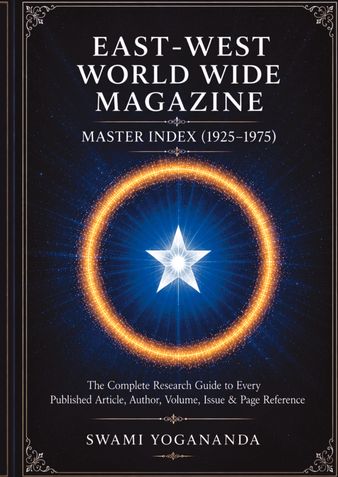
East–West World Wide Magazine | Master Index (1925–1975)
(The Complete Research Guide to Every Published Article, Author, Volume, Issue and Page Reference)
Swami YoganandaType:
Print Book
Genre: Magazine/Periodical, Antiques & Collectibles
Language: English
Price:
₹821
+ shipping
Description
This book is intended as a resource for historians of the Self-Realization Magazine. From its start by Swami Yogananda in 1925 it has had different names, starting with East-West World-Wide magazine (as discussed by Yoganandaji, "World Wide" was suggested by Luther Burbank), then in 1932 Inner Culture replaced World Wide, so the magazine was titled East West Inner Culture Magazine through April, 1934. The name then was reversed in May 1934 to Inner Culture East-West Magazine through late 1937. At that time, it became Inner Culture the Magazine of India until April 1934 when the title changed to Inner Culture for Self-Realization.
Then in the quarterly issue of July-September 1944 editor L. V. Pratt announced that the name would revert permanently to its original East-West name. Even so in September 1948 East West took a new name because, as it was announced, "the name East-West has not expressed fully the character of [the magazine's] purpose…we have found one that is suitable; that is Self-Realization." The Self- Realization Magazine has been its name since then. Occasionally in this guide the acronym SRM will be employed for Self-Realization Magazine.
In 1963 (Index to Volume 34, 1962—63) the SRM started publishing an Index in the final issue of each Volume and these are herein included. The SRM was published variously, whether monthly, bimonthly, quarterly, depending on finances. The Fall 1975 edition of the Self Realization Magazine is the final issue included in this third edition. There is a reason, that no further photographic copies are available to the compiler; this edition concludes with the issues containing Yogananda's Conclusion to his Spiritual Interpretation of the Bhagavad Gita (a 43-year publishing undertaking). Each magazine issue is represented by a photographic image of its Table of Contents.
The Editors are pleased to make this Master Index (The Complete Research Guide to Every Published Article, Author, Volume, Issue and Page Reference) available for the devotees around the world. Before this, no one had even thought of doing such an extraordinary project. This work has been completed through the Blessings of Divine Gurudeva and lovingly offered at HIS Holy Feet.
About the Author
Book Details
Publisher: Swami Yogananda
Number of Pages: 339
Dimensions: 8.27"x11.69"
Interior Pages: B&W
Binding:
Paperback (Perfect Binding)
Availability:
In Stock (Print on Demand)
Ratings & Reviews
East–West World Wide Magazine | Master Index (1925–1975)
Review This Book
Write your thoughts about this book.

Currently there are no reviews available for this book.
Be the first one to write a review for the book East–West World Wide Magazine | Master Index (1925–1975).
Other Books in Magazine/Periodical, Antiques & Collectibles
HINDI VIGYAN SAHITYA PARISHAD (HVSP)

जसवंत लोधी
Men's HUB Team, Daaman Team
தமிழ் நண்பர்கள்