You can access the distribution details by navigating to My Print Books(POD) > Distribution
Add a Review
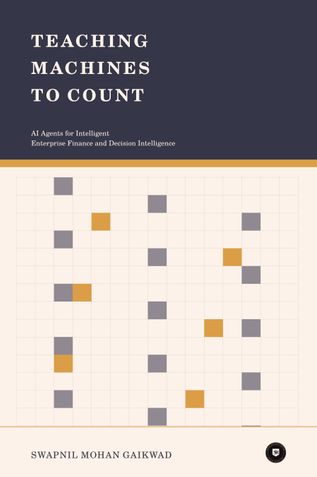
Teaching Machines to Count
AI Agents for Intelligent Enterprise Finance and Decision Intelligence
Swapnil Mohan GaikwadType:
Print Book
Genre: Computers & Internet
Language: English
Price:
₹1,899
+ shipping
This book ships within India only.
Description
Every invoice line, every reconciled transaction, every reported exposure is a number someone had to arrive at and then be able to defend. Rule-based systems break on the variety of real documents; people do not scale to the volume. This book asks what an autonomous agent would need before that work could be handed to it.
Across ten studies it builds the parts. Retrieval that weighs numeric precision against regulatory coverage and temporal order instead of similarity alone. Memory that adapts when a data schema shifts underneath it. Task decomposition an SMT solver can certify against written compliance rules. Fraud detection that learns from transaction graphs without ever seeing a labelled fraud. And adversarial stress-testing that breaks the whole arrangement on purpose, before real capital does.
It is written for researchers, architects and finance technologists who are past being impressed by a chatbot that can read a 10-K, and are asking the harder question: how do you build a system a compliance officer, an auditor and a CFO will all put their name to?
About the Author
Book Details
ISBN: 9788118131205
Publisher: SHORAM Editorial Services
Number of Pages: 260
Dimensions: 6"x9"
Interior Pages: Full Color
Binding:
Paperback (Perfect Binding)
Availability:
In Stock (Print on Demand)
Ratings & Reviews
Teaching Machines to Count
Review This Book
Write your thoughts about this book.

Currently there are no reviews available for this book.
Be the first one to write a review for the book Teaching Machines to Count.
Other Books in Computers & Internet
M. Kumari, C.B. Kumar

Vimal Kumar V

JOANNE MASON
Pratik Kikani