You can access the distribution details by navigating to My Print Books(POD) > Distribution
Add a Review
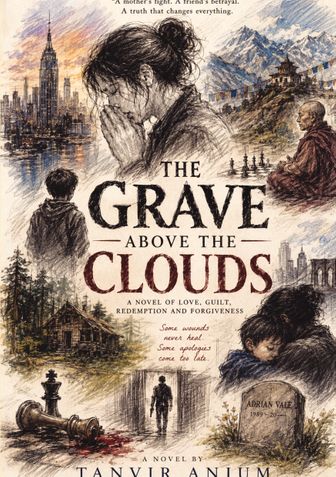
Description
PREFACE
Some stories are written to entertain us.
Some are written to frighten us.
And some are written because the writer cannot leave the characters alone until they have said what they came to say.
The Grave Above the Clouds belongs to the third kind.
At its heart, this is a story about a mother and her son. But beneath that relationship lies something more complicated: fear, memory, friendship, obsession, guilt, forgiveness, and the terrible consequences of the things we fail to notice in the people we love.
Miriam Hale begins this journey believing that the greatest danger in her life is losing her child.
She is wrong.
The greatest danger is what happens to a person after loss.
When fear remains for years, it changes the way we see the world. When guilt remains buried, it changes the way we remember the past. And when someone else's pain goes unnoticed for too long, it can become something neither person knows how to escape.
This novel travels from the streets of New York to the silence of the Himalayas, from childhood terror to adulthood, from a chessboard to a forest, and finally to a grave.
But the mountains in this story are not merely mountains.
The chessboard is not merely a chessboard.
And the grave is not merely a grave.
Each is a symbol of something Miriam has spent years trying to understand.
The Himalayas represent the distance she must travel to find herself again. The chessboard represents the choices we make without knowing what the next move will cost. And the grave represents the final truth that some apologies arrive too late.
I wanted this story to ask a difficult question:
Can we forgive ourselves for the things we did not know?
There are moments when Miriam must confront a painful realization—that being a victim does not mean she has never hurt anyone. That discovering another person's suffering does not excuse the terrible things they may have done. And that understanding someone is not the same as forgiving everything they have done.
Life rarely gives us simple villains and perfect heroes.
Sometimes the person who hurts us was once the person who loved us.
Sometimes the person we ignored was silently falling apart.
Sometimes we discover the truth only after there is no one left to answer our questions.
And sometimes, all we can do is stand before a grave and say:
I'm sorry.
This book is also about a different kind of love—the quiet, enduring love between a mother and her child. Ethan's journey is not merely the story of a kidnapped boy. It is the story of a child growing up beneath the shadow of his mother's fear, learning that survival is not the same thing as healing.
Tenzin, the monk in the mountains, represents another truth: healing does not always come from forgetting.
Sometimes it comes from learning how to remember without being destroyed by the memory.
His lessons about chess, discipline, and self-defense are ultimately lessons about life itself.
You cannot control every move.
You cannot prevent every loss.
You cannot return to the beginning and choose differently.
But you can decide what your next move will be.
That is what this novel is ultimately about.
The next move.
The decision to live after loss.
The decision to love after fear.
The decision to forgive without forgetting.
And, perhaps most difficult of all, the decision to forgive yourself.
If you are reading these pages, I hope you do not simply ask yourself who is right and who is wrong.
Instead, ask yourself:
Who was hurting?
Who was listening?
Who was forgotten?
And how many tragedies begin simply because someone failed to ask another person,
"Are you all right?"
There are graves beneath the earth.
There are memories buried inside us.
And there are truths hidden above the clouds.
This is the story of one mother who spent years searching for her son—and eventually discovered that the longest journey was not the one that took her from New York to the Himalayas.
It was the journey back to herself.
I invite you to take that journey with her.
And when you finally reach the grave above the clouds, I hope you pause there for a moment.
Listen to the silence.
Remember the people you love.
Remember the people you may have forgotten.
And ask yourself what words you would say if you knew you would never get another chance.
Because sometimes—
the hardest words to say are the ones we waited too long to speak.
— Tanvir Anjum
About the Author
Book Details
ISBN: 9798246910221
Publisher: Sajuma Khatun
Number of Pages: 122
Dimensions: 5.83"x8.27"
Interior Pages: B&W
Binding:
Paperback (Perfect Binding)
Availability:
In Stock (Print on Demand)
Ratings & Reviews
THE GRAVE ABOVE THE CLOUDS
Review This Book
Write your thoughts about this book.

Currently there are no reviews available for this book.
Be the first one to write a review for the book THE GRAVE ABOVE THE CLOUDS.
Other Books in Literature & Fiction

Dr. Priyanka Vats

Seyed E.zamani

ANKIT ABHISHEK

Anjana D. Prajapati, Lalji S. Chaudhary