You can access the distribution details by navigating to My Print Books(POD) > Distribution
Add a Review

ஹரப்பா பேசும்போது
Perumal Pugazhendhi
Halahal: The Autopsy of an Empire
Abhishek Goel
देवदत्त
दीपक गायकवाड
The Wants and Means of India
Dadabhai Naoroji
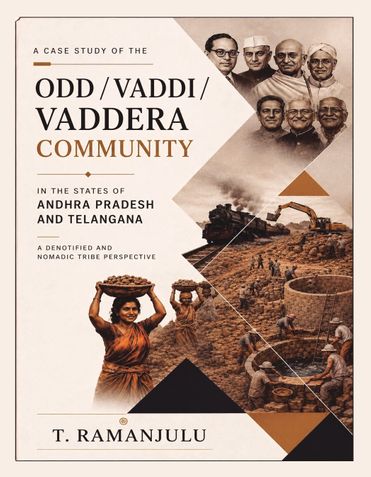
A CASE STUDY OF THE ODD / VADDI / VADDERA COMMUNITY IN THE STATES OF ANDHRA PRADESH AND TELANGANA
A Denotified and Nomadic Tribe Perspective
Tirumalakonda RamanjuluType:
Print Book
Genre: Politics & Society, History
Language: English, Telugu
Price:
₹610
 Free Shipping
Description
☞ Dear reader…
Reading just this single page will help you understand why this book was written…
The history of India is not merely a chronicle of kings, wars, empires, and freedom struggles…
It is also the story of the tears shed by millions of marginalized people whose names do not appear in the pages of history.
During British rule, Indian caste society was divided into various official categories for the sake of administrative convenience, social control, and political gain.
☞ “Depressed Classes”
☞ “Exterior Castes”
☞ “Untouchable Castes”
☞ “Criminal Tribes”
These terms are not just names…
They are official classifications that determined the lives, social status, and futures of millions of people.
While terms like “Depressed Classes,” “Exterior Castes,” and “Untouchable Castes” primarily referred to caste communities subjected to untouchability and social ostracism…
The term “Criminal Tribes” remains in history as a dreaded stigma branded by British colonial rulers upon numerous nomadic, semi-nomadic, and other caste communities. Under the Criminal Tribes Act of 1871, many such communities were officially notified as groups; their freedom of movement was curtailed, and they were subjected to systems involving police surveillance and mandatory registration. ☞ Instead of investigating a crime committed by an individual...
Viewing an entire caste community with suspicion...
Stigmatizing a family's past and their children's future...
Linking the very identity of a caste community to criminality...
This is one of the most painful historical injustices created by colonial rule.
Against this backdrop, viewing Dr. B.R. Ambedkar’s struggle merely as a "movement for the rights of Untouchables" fails to fully reflect the breadth of his vision for social justice.
Although the rights of the Depressed Classes, Untouchable communities, and "Exterior Castes" were central to his political, social, and constitutional struggles, the values he championed—liberty, equality, fraternity, and human dignity—are relevant to every oppressed individual.
What Ambedkar opposed was not merely the injustice inflicted upon a single caste.
☞ What he challenged was—
"Social Exclusion"
and
"Hereditary Inequality."
A person's birth should not determine their dignity.
The caste community into which a person is born should not shut off their opportunities.
The stigma imposed on past generations should not penalize the future of subsequent generations. Within this broad framework of social justice, one can understand the issues of human dignity, equal opportunities, and rights concerning caste communities subjected to untouchability, Adivasis, nomadic and semi-nomadic communities, De-notified Tribes (DNTs), landless laborers, and other marginalized sections.
Articles 14–18 of the Indian Constitution laid the foundation for a system of equality.
Article 15 provided constitutional protection against discrimination.
Article 16 established the constitutional basis for equality of opportunity in public employment.
Article 17 abolished untouchability.
The constitutional framework regarding social justice, representation, educational opportunities, and protective discrimination instilled new hope in the lives of marginalized sections.
Therefore, Ambedkar cannot be viewed merely as a leader belonging to a single section.
His struggle was one that challenged the historical inequalities of India.
It was a struggle that upheld human dignity as a constitutional value.
It was a struggle waged against a system that determined a person's future based on birth.
That is why India's social history conveys a profound message to us—
“Colonial rulers divided the people into administrative categories…
But the Constitution of independent India paved the way to recognize them as citizens with equal dignity.”
This stands as one of the most significant transformations in the journey of Indian democracy. ☞ There is more history for us to understand…
Why was the Criminal Tribes Act (1871–1952) enacted?
What was the colonial mindset behind it?
How was police surveillance implemented over the communities notified under this Act?
What impact did it have on their freedom of movement, traditional occupations, family life, their children's future, and social dignity?
Did their lives truly change after the de-notification in 1952?
Or…
Did the stigma of suspicion against the community persist even after the Act was repealed?
Let us find answers to these questions through the chapters of this book, exploring historical evidence, government policies, reports from committees and commissions, constitutional developments, and social realities.
☞ The Vaddera Community
A Historical Journey — A Struggle for Survival
In this book, we will also examine the historical journey of the Vaddera community.
What were their social, economic, and occupational conditions prior to independence?
How did colonial policies affect their lives?
To what extent have their lives changed following independence, the adoption of the Constitution, and the implementation of welfare policies?
Let us examine these aspects.
How far has education reached the hands that once broke stones?
Did the families who toiled for nation-building achieve financial security?
Did their children receive equal opportunities?
Let us discover what history, government policies, and the reports of committees and commissions have recorded regarding the living conditions of the Vaddera community. ☞ Through this book, let us explore the historical background, living conditions, socio-economic evolution, and enduring challenges of the Vaddi/Vaddara community—a group historically classified under the 'Criminal Tribes' list.
This is not merely the history of a law—
It is the ongoing struggle for identity, dignity, and social justice waged by a community.
About the Author
Book Details
ISBN: 9789358104899
Publisher: Self Published
Number of Pages: 277
Dimensions: 7.00"x9.00"
Interior Pages: B&W
Binding:
Paperback (Perfect Binding)
Availability:
In Stock (Print on Demand)
Ratings & Reviews
A CASE STUDY OF THE ODD / VADDI / VADDERA COMMUNITY IN THE STATES OF ANDHRA PRADESH AND TELANGANA
Review This Book
Write your thoughts about this book.
Currently there are no reviews available for this book.
Be the first one to write a review for the book A CASE STUDY OF THE ODD / VADDI / VADDERA COMMUNITY IN THE STATES OF ANDHRA PRADESH AND TELANGANA.
Other Books in Politics & Society, History
Perumal Pugazhendhi

Abhishek Goel

दीपक गायकवाड

Dadabhai Naoroji