You can access the distribution details by navigating to My Print Books(POD) > Distribution
Add a Review
This book ships within India only.
Description
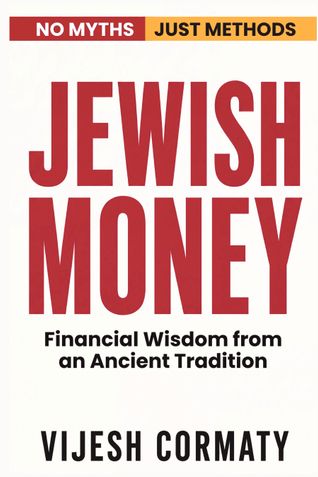
What if the most tested financial system in history has been sitting in plain sight — and almost nobody has read it properly?
Two tenths of one percent of the world's population. Roughly 20 percent of all Nobel laureates since 1901. Consistent economic resilience across six continents and three thousand years — through expulsion, dispossession, and catastrophe.
This is not luck. Luck does not repeat across a thousand years. Something is being transmitted. Jewish Money is the most honest investigation of what that something actually is.
This is not the book you expect it to be.
Vijesh Cormaty is an Indian banker — not Jewish, not a rabbi, not a motivational speaker. He came to this material the way an engineer approaches a machine that has been running without breaking for three millennia: he wanted to know what was inside it.
After eight years watching thousands of financial lives from behind a bank desk — watching the same salary produce two completely different outcomes in people sitting in the same chair on the same afternoon — he found his answer. It was not a secret. It was a set of defaults, and defaults survive bad weeks in a way that decisions never do.
What this book actually contains:
The documented history of how medieval restrictions accidentally created portfolio advantages — and what that means for how you hold assets today
The Cairo Geniza letters: six hundred years of ordinary business correspondence that reveal how a trading network spanning the Mediterranean ran entirely on reputation as collateral
The Rothschild story — including the 1846 antisemitic pamphlet that invented the Waterloo manipulation legend, why it still circulates, and what the family actually built (a logistics capability, not a conspiracy)
Larry Fink and eleven trillion dollars that belong to pension funds and nurses, not to him — and why the fee you pay to invest is the only variable in your financial life with a guaranteed outcome
The Hasidic community that is poor on paper and produces business owners at a rate that should not be possible — and the exact mechanism that explains both facts simultaneously
Eighteen lines. One sheet of paper. The only financial checklist built from three thousand years of catastrophe-tested practice rather than a bull market
What makes this different from every other book in this category:
Every statistic has a named source. Every famous story that turned out to be a myth is flagged as one — including several the author repeated in earlier work and has since corrected. The book does not promise secrets. It studies a body of practice that is publicly available, largely unread, and embarrassingly unglamorous.
The tradition it examines has been tested against things most financial advice has never encountered: expulsion, asset confiscation, currency collapse, and the specific cruelty of being stripped to zero and having to rebuild from knowledge alone. What survived those tests is not a strategy. It is a set of defaults that work while you are not paying attention.
A NOTE ON WHAT THIS BOOK IS NOT
It is not a claim that Jewish people are uniformly wealthy. They are not — Jewish poverty is real and under-discussed. It is not a hidden-hand theory. Every institution described in this book is publicly registered, files audited accounts, and can be looked up. And it is not a religious conversion. The author is a Christian. The practices described can be adopted by anyone, regardless of background or belief, because practices — unlike ancestry — can be learned.
Jewish Money is the second book in the Jewish Wealth Mastery Series. It stands alone. Readers who want the eight-question framework before the historical mechanics should begin with Jewish Wisdom for Financial Freedom.
Little by little, it becomes big.
About the Author
Book Details
ISBN: 9789359337708
Publisher: Vijesh Cormaty
Number of Pages: 280
Dimensions: 6.00"x9.00"
Interior Pages: B&W
Binding:
Paperback (Perfect Binding)
Availability:
In Stock (Print on Demand)
Ratings & Reviews
Jewish Money
Review This Book
Write your thoughts about this book.

Currently there are no reviews available for this book.
Be the first one to write a review for the book Jewish Money.
Other Books in Business & Economics

Anshuman Sharma

NEERAJ SHARMA

B SWAMINATHAN, V D TARPARA, N J ARDESHNA

Dr. Satheesh Kumar Nair