You can access the distribution details by navigating to My Print Books(POD) > Distribution
Add a Review
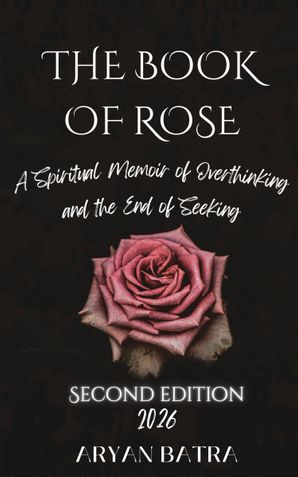
THE BOOK OF ROSE : A Spiritual Memoir of Overthinking and the End of Seeking
A Spiritual Memoir of Overthinking and the End of Seeking
Aryan BatraDescription
Rose is not a character in this book. Rose is me. I wrote my own story in the third person because for years I could not look at myself directly. When someone told me to do something, I could not do it. I thought about it. I thought about why I could not do it. I thought about what would happen if I did. I thought until the day was gone. Whatever I did, I wanted it to be perfect. A task that would take one day took three or four. I planned my life for the next year, the next two years. I made the perfect plan to fix every- thing. I never did what I planned. I started for thirty minutes, and the thoughts ran six months ahead. They said it was overthinking. Then they said it was perfectionism. Then they said it was anxiety. I had a name for everything. I still could not do it. I read every book of wisdom I could find, and none of them moved me. Jiddu Krishnamurti took away my beliefs. Kapil Gupta MD took away my excuses. The Buddhist meditations gave me peace, and peace did not move me. The mantras became a weight on my mind. The death meditation took away my fear and left me with more thoughts. They all walked me back to the same place: the mind. Then I found the poem ‘We Are What We Think.’ It was the first poem of the Dhammapada, translated by Thomas Byrom and
read in Osho’s twelve-volume Buddha series. It did not give me a method. It gave me a mirror. I made the poem my prayer. I prayed with it in the morning for many months. The poems Non Self, Love, and Sunyata came from that prayer. I burned all the books in my mind. I have not read a spiritual book since. The migraine came after the search. Days and nights of throbbing pain. Sound became a knife. All the knowledge was useless. I saw that thinking and planning were part of the hammer, and I became the executioner I had always wanted to be: the man who does the thing in front of him, at the cost of his life. I live between pain and philosophy now. I have found a balance, but it is not the balance the books describe. I am grateful for the pain. It is not a subject I chose; it is the weather I write in. It shaped The Tragedy of Sound. I have no dreams for myself. I have one wish: to finish the work I was sent to do, and then to go. I do not yet know what the work is. The book has ten chapters. One is my own story, under the name Rose. Two is what remained when the thinking finished. Three is The World Is a Long Dream: the meditation on the “I,” the empty mind, non-dualism, and the philosophy of dreams. Four is the questions. Five is the diary. Six is the old diary. Seven is the world as a mirror. Eight is the practice, with all forty-one practices printed in full. Nine is the philosophy. Ten is the fragile man, a bonus chapter written after the migraine and the years of sound. The appendices gather the sources, the practices, and the poems. A is a list of sources and further reading. B is ‘We Are What We Think,’ from the Dhammapada, translated by Thomas Byrom, as read in Osho’s twelve-volume Buddha series; all rights in the translation remain with its rights holders. C is the opening of the Japji Sahib of Guru Nanak, in the English rendering supplied for this edition. D is Janaka’s Last Words, Chapter 20 of the Ashtavakra Gita, in a rendering from the Sanskrit, and is referred to in Chapter Nine. The underlying texts of C and D are in the public domain. E is The Only Reason, a short passage from Kapil Gupta, MD, quoted for reference. F is a short selection from Nagarjuna’s Sixty Stanzas, after the translation from the Tibetan by Muditāśrī and Palsap Nyima Grags. G is a short excerpt from ‘The Core of Krishna- murti’s Teaching’ (1980), © Krishnamurti Foundation Trust. H is a short excerpt from the screenplay Don’t Believe His Lies (Me- mento), written by Christopher Nolan, based on the short story Memento Mori by Jonathan Nolan, © 2000 Christopher Nolan. I is the forty-one practices, kept in the order I found and used them; all forty-one are also printed in Chapter Eight. J is the Heart Sutra, as recited in the Triratna Buddhist Community, and is referred to in Chapter Nine. K and L gather the early and the later poems. M is The Tragedy of Sound. The chapters and all original matter in this book are the copyright of Aryan Batra. The only exception is the brief quotations from other authors, which are attributed, used for reference and fair use, and remain with their rights holders. No part of this book may be reproduced in any form without written permission from the author, except for brief quotations in a review.
About the Author
Book Details
Publisher: Aryan Batra
Number of Pages: 338
Dimensions: 5"x8"
Interior Pages: B&W
Binding:
Paperback (Perfect Binding)
Availability:
In Stock (Print on Demand)
Ratings & Reviews
THE BOOK OF ROSE : A Spiritual Memoir of Overthinking and the End of Seeking
Review This Book
Write your thoughts about this book.

Currently there are no reviews available for this book.
Be the first one to write a review for the book THE BOOK OF ROSE : A Spiritual Memoir of Overthinking and the End of Seeking.
Other Books in Philosophy

डॉ. पार्थ मजुमदार

Ajai Kumar Chhawchharia

Vejella Siva Rama Prasad

Subramaniya Bharathiyar