You can access the distribution details by navigating to My Print Books(POD) > Distribution
Add a Review
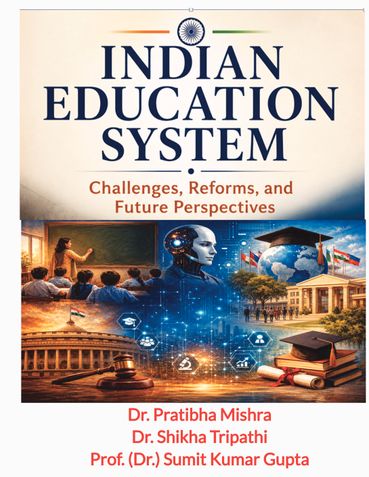
Indian Education System Challenges, Reforms and Future Perspectives
Indian Education System Challenges, Reforms and Future Perspectives
Dr. Pratibha Mishra Dr. Shikha Tripathi Prof. (Dr.) Sumit Kumar Gupta
This book ships within India only.
Description
India possesses one of the world's largest and most diverse education systems, serving more than 260 million school students and over 43 million higher education learners. Rapid technological advancement, globalization, demographic changes, digital transformation, and the implementation of the National Education Policy (NEP) 2020 have created unprecedented opportunities for educational reform while simultaneously exposing persistent structural challenges.This book provides a comprehensive and multidisciplinary examination of India's education ecosystem, integrating historical development, policy evolution, governance structures, institutional reforms, quality assurance, digital transformation, equity, inclusion, teacher development, research ecosystems, employability, and future educational trends.The volume bridges academic theory with policy implementation and practical applications through evidence-based discussions, statistical analysis, international comparisons, case studies, and contemporary research. It offers strategic recommendations for building an inclusive, equitable, technology-enabled, research-driven, and globally competitive education system aligned with India's Vision 2047.
Aim of the Book
To provide a comprehensive scholarly analysis of the Indian education system by examining its evolution, current challenges, policy reforms, governance mechanisms, quality initiatives, technological innovations, and future directions, thereby supporting evidence-based research and informed educational policymaking.
Objectives
The book aims to:
1. Examine the historical evolution of education in India.
2. Analyse the structure and governance of school and higher education.
3. Evaluate major educational reforms and policy initiatives.
4. Critically assess the implementation of NEP 2020.
5. Examine issues related to equity, inclusion and access.
6. Investigate quality assurance and accreditation mechanisms.
7. Explore digital transformation and educational technologies.
8. Analyse teacher education and professional development.
9. Examine research, innovation and knowledge creation.
10. Evaluate vocational education and skill development initiatives.
11. Study financing and governance challenges.
12. Compare Indian education with global best practices.
13. Explore Artificial Intelligence and emerging technologies in education.
14. Recommend policy interventions for strengthening educational outcomes.
15. Present future strategies aligned with Sustainable Development Goal 4 (Quality Education) and India's Vision 2047.
Scope of the Book
The book covers:
• Historical development of Indian education
• Constitutional provisions and educational governance
• School education reforms
• Higher education reforms
• National Education Policy 2020
• Digital education
• Artificial Intelligence in education
• Educational Technology (EdTech)
• Teacher education
• Curriculum reforms
• Assessment reforms
• Vocational education
• Skill development
• Inclusive education
• Gender equity
• Educational finance
• Educational leadership
• Research and innovation
• Academic quality assurance
• Accreditation and rankings
• Indian Knowledge Systems
• Internationalization of higher education
• Sustainable Development Goals
• Future education models
Unique Features of the Book
Unlike conventional books that focus on a single aspect of Indian education, this volume provides an integrated and forward-looking perspective by combining policy analysis, empirical evidence, educational theory, technological innovation, and global benchmarking.
Key distinguishing features include:
• Comprehensive coverage from school to higher education
• Critical evaluation of NEP 2020 implementation
• Integration of Artificial Intelligence and digital learning
• Dedicated chapters on research, innovation and entrepreneurship
• Comparative international education perspectives
• Policy-oriented recommendations
• Evidence-based discussions supported by current reports and datasets
• Case studies from Indian educational institutions
• Focus on sustainability, inclusion and equity
• Discussion of Indian Knowledge Systems and multidisciplinary education
• Alignment with SDG 4 and Vision 2047
• Suitable as both a reference text and research handbook
Target Audience
The book is intended for:
• University faculty members
• Researchers
• Ph.D. scholars
• M.Phil. scholars
• Postgraduate students
• Teacher educators
• Educational administrators
• School leaders
• Vice Chancellors
• Policymakers
• Government officials
• Educational planners
• Accreditation professionals
• Curriculum developers
• NGOs working in education
• International education researchers
• Development agencies
• Think tanks
• EdTech professionals
The book can serve as a reference for programmes in:
• Education
• Educational Administration
• Public Policy
• Sociology of Education
• Higher Education Studies
• Teacher Education
• Educational Technology
• Development Studies
• Public Administration
About the Author
Book Details
ISBN: 9789359376479
Publisher: SKG Publication, Jaipur
Number of Pages: 198
Dimensions: 7"x9"
Interior Pages: B&W
Binding:
Hard Cover (Case Binding)
Availability:
In Stock (Print on Demand)
Ratings & Reviews
Indian Education System Challenges, Reforms and Future Perspectives
Review This Book
Write your thoughts about this book.

Currently there are no reviews available for this book.
Be the first one to write a review for the book Indian Education System Challenges, Reforms and Future Perspectives.
Other Books in Education & Language

SRI

Mrs. Sonali Pahria

ANURAG MATHUR