You can access the distribution details by navigating to My Print Books(POD) > Distribution
Add a Review
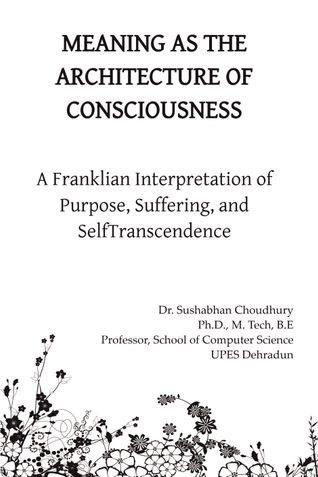
MEANING AS THE ARCHITECTURE OF CONSCIOUSNESS
MEANING AS THE ARCHITECTURE OF CONSCIOUSNESS
Dr. Sushabhan ChoudhuryDescription
Meaning as the Architecture of Consciousness advances a sustained philosophical thesis: meaning is not merely content that fills consciousness, but the very structure that renders consciousness coherent. Drawing on three profound traditions—Viktor Frankl’s logotherapy and philosophical anthropology, Rabindranath Tagore’s spiritual poetry and Upanishadic legacy, and the metaphysical and ethical teachings of the Bhagavad Gita—the book contends that human beings are not just seekers of meaning, but are fundamentally constituted by it. Without an orientation toward meaning, consciousness does not simply languish; it begins, in observable psychological and physiological terms, to fragment.
The book opens with what its introduction terms the problem of the empty self: the paradox that, in an age of technological saturation and material abundance, we face unprecedented rates of depression, anxiety, and existential emptiness. Viktor Frankl’s concept of the existential vacuum—first theorized in the aftermath of World War II and supported by decades of psychological research—serves as an initial diagnosis. Yet the book quickly moves beyond diagnosis, offering a philosophical account of why meaning is not a secondary feature of mind, but its very ground.
Three thematic pillars organize the inquiry: Purpose, Suffering, and Self-Transcendence. Each is examined through the converging insights of Frankl, the Gita, and Tagore—traditions separated by culture and era, yet, as the book demonstrates, arriving at structurally analogous insights into the human condition. The method is what the author terms cross-traditional phenomenology: a close attention to what diverse traditions have revealed about the structure of lived experience, and a search for the enduring patterns that transcend cultural boundaries.
The book also engages with contemporary neuroscience—not to reduce meaning to neurobiology, but to demonstrate that even empirical studies of consciousness repeatedly converge on questions long explored by philosophers and mystics. Research on the default mode network, attitudinal values, and the physiological impacts of meaning on health and longevity offers scientific corroboration for claims reached by Frankl, the Gita, and Tagore by other means.
The final chapter turns from theory to practice. Drawing on all three traditions, it sets forth a practical philosophy of meaning structured around three fundamental orientations—Attention, Commitment, and Acceptance—and illustrates how these can be lived in the fabric of everyday life. The book closes not with a definitive answer to the problem of existence, but with an invitation: to dwell fully in our lived experience, which, it suggests, is all that is ever truly required of us.
About the Author
Book Details
ISBN: 9789359432960
Publisher: Zenodo
Number of Pages: 326
Dimensions: 6"x9"
Interior Pages: B&W
Binding:
Hard Cover (Case Binding)
Availability:
In Stock (Print on Demand)
Ratings & Reviews
MEANING AS THE ARCHITECTURE OF CONSCIOUSNESS
Review This Book
Write your thoughts about this book.

Currently there are no reviews available for this book.
Be the first one to write a review for the book MEANING AS THE ARCHITECTURE OF CONSCIOUSNESS.
Other Books in Philosophy

डॉ. मुकेश कुमार पाठक

RAJKUMAR NAL GRIVANS

The Great Ravan Khan MASHUK -E-KHUDA

SAMPAT DANIEL