You can access the distribution details by navigating to My Print Books(POD) > Distribution
Add a Review
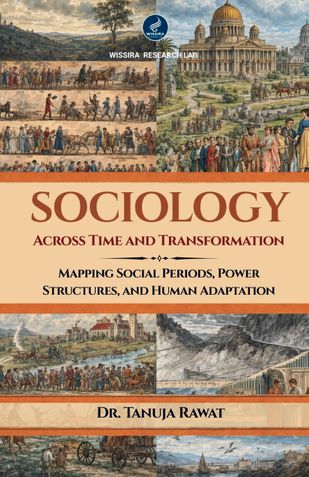
Sociology Across Time and Transformation: Mapping Social Periods, Power Structures, and Human Adaptation
Dr. Tanuja Rawat
Description
Human society has never remained static. Across centuries, communities have continuously reorganized themselves in response to changing environments, technologies, economies, political systems, cultural beliefs, and structures of authority. From small kinship-based groups to agrarian civilizations, feudal arrangements, industrial societies, colonial orders, global networks, and digitally connected communities, each historical period has created distinctive forms of social organization.
Sociology Across Time and Transformation: Mapping Social Periods, Power Structures, and Human Adaptation has been developed to examine this long and complex journey through a sociological perspective. The book is based on the understanding that society cannot be studied only as a collection of institutions or isolated historical events. Social life must instead be viewed as an evolving relationship among individuals, communities, power structures, cultural systems, technologies, economic arrangements, and political institutions.
The purpose of this book is to connect sociological theory with historical transformation. It introduces readers to the ways in which early societies formed patterns of cooperation, authority, hierarchy, and collective identity. It then traces how agricultural settlement, state formation, traditional authority, feudal relations, industrialization, capitalism, colonialism, and modern institutions transformed social relationships. The later chapters extend this analysis to social movements, globalization, digital communication, artificial intelligence, climate change, migration, demographic transitions, and the future of human adaptation.
A central theme running throughout the book is the relationship between structure and agency. Social institutions shape individual choices by defining roles, expectations, opportunities, and limitations. However, individuals and groups are not powerless within these arrangements. Through negotiation, innovation, resistance, collective action, and cultural reinterpretation, people continually reproduce and transform the social world.
The book adopts a broad comparative and interdisciplinary approach. Sociology remains its primary foundation, but the discussion also draws upon history, anthropology, political science, economics, cultural studies, environmental studies, and technology studies. This approach is necessary because major social transformations rarely belong to one field alone. Industrialization, colonialism, globalization, climate change, and artificial intelligence are simultaneously economic, political, cultural, technological, and social processes.
This book ultimately argues that no social order is entirely permanent and no transformation is socially neutral. Every major change redistributes relationships, opportunities, responsibilities, and forms of power. Sociology enables readers to examine these processes critically while recognizing the creativity and resilience of human communities.
It is hoped that this volume will encourage readers to look beyond surface-level descriptions of social change and explore the deeper relationships among history, institutions, inequality, culture, technology, and human action. By mapping societies across time, the book seeks to strengthen understanding of both the forces that shape collective life and the possibilities available for building more inclusive, sustainable, and adaptable social futures.
About the Author
Book Details
ISBN: 9789375590354
Publisher: Wissira Research Lab
Number of Pages: 146
Dimensions: 5.5"x8.5"
Interior Pages: Full Color
Binding:
Paperback (Perfect Binding)
Availability:
In Stock (Print on Demand)
Ratings & Reviews
Sociology Across Time and Transformation: Mapping Social Periods, Power Structures, and Human Adaptation
Review This Book
Write your thoughts about this book.

Currently there are no reviews available for this book.
Be the first one to write a review for the book Sociology Across Time and Transformation: Mapping Social Periods, Power Structures, and Human Adaptation.
Other Books in Social Science

Ranjan Solomon


सुरेश चन्द्र तिवारी (Suresh Chandra Tiwari)
Maria Cristina De Lorenzo