You can access the distribution details by navigating to My pre-printed books > Distribution
Add a Review
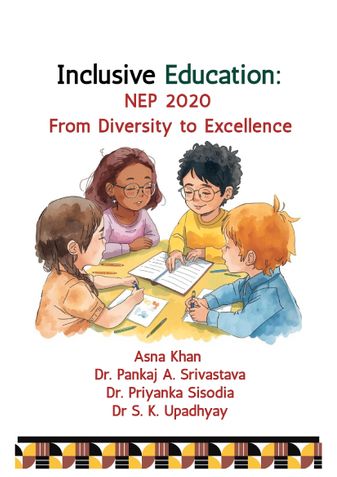
Inclusive Education: NEP 2020 From Diversity to Excellence (eBook)
Type:
e-book
Genre: Education & Language
Language: English
Price:
₹200
(Immediate Access on Full Payment)
Description
Education stands at the heart of every progressive society, shaping not only individual futures but also the collective destiny of nations. In an increasingly diverse world, classrooms mirror the complexity of human experience-differences in culture, language, ability, socio-economic background, and learning styles converge within a single learning space. The challenge before educators is not merely to accommodate this diversity, but to harness it as a powerful resource for collective growth. This book, Inclusive Education: NEP 2020 - From Diversity to Excellence, emerges from the recognition that true educational excellence can only be achieved when every learner is valued, supported, and empowered.
The National Education Policy 2020 represents a significant milestone in India’s educational reform journey. It envisions an equitable system that ensures access, participation, and meaningful learning for all students, especially those who have historically been marginalized. The policy moves beyond the narrow goal of enrolment to emphasize holistic development, flexibility, and lifelong learning. However, translating this vision into classroom reality requires thoughtful understanding, practical strategies, and sustained commitment from educators, institutions, policymakers, and communities. This book seeks to bridge that gap by presenting inclusive education not as an abstract ideal but as an actionable framework.
At its core, inclusive education is founded on the belief that diversity is not a problem to be solved but a strength to be cultivated. When students from different backgrounds learn together, they develop empathy, cooperation, and critical thinking skills essential for democratic citizenship. Inclusive classrooms foster respect for human dignity and prepare learners to participate in a pluralistic society. By integrating perspectives from pedagogy, psychology, sociology, and policy studies, this work highlights how inclusive practices contribute not only to individual success but also to social cohesion and national development.
The chapters in this book examine multiple dimensions of inclusion-legal foundations, policy frameworks, classroom diversity, disability inclusion, socio-economic equity, multilingual education, teacher preparation, technological innovation, and future directions. Each section emphasizes practical insights alongside conceptual understanding, making the content relevant for teachers, teacher educators, researchers, administrators, and students of education. Real-world examples and case-based discussions illustrate how inclusive principles can be implemented across varied contexts.
It is important to acknowledge that inclusive education is an ongoing process rather than a final destination. Challenges such as resource limitations, attitudinal barriers, and uneven implementation persist in many regions. Nevertheless, progress is possible when stakeholders collaborate and remain committed to the vision of equitable learning for all. This book aspires to serve as both a guide and an inspiration for those working toward that goal.
Ultimately, education must move beyond uniformity toward responsiveness, beyond exclusion toward participation, and beyond mere access toward excellence. If this work contributes in even a small way to building classrooms where every child feels seen, heard, and capable of success, it will have fulfilled its purpose. The future of education lies not in teaching a select few effectively, but in enabling every learner to flourish.
About the Authors
Book Details
ISBN: 9789375592037
Publisher: Wissira Research Lab
Number of Pages: 139
Availability:
Available for Download (e-book)
Ratings & Reviews
Inclusive Education: NEP 2020 From Diversity to Excellence
Review This Book
Write your thoughts about this book.

Currently there are no reviews available for this book.
Be the first one to write a review for the book Inclusive Education: NEP 2020 From Diversity to Excellence.
Other Books in Education & Language
Ramakrishna Garine, Priyam Ganguly, Nagaraju Dasari, Ranita Ganguly
JOJO JOSEPH
kamyabology.com, the science of success
U.A.Kiran