You can access the distribution details by navigating to My pre-printed books > Distribution
Add a Review
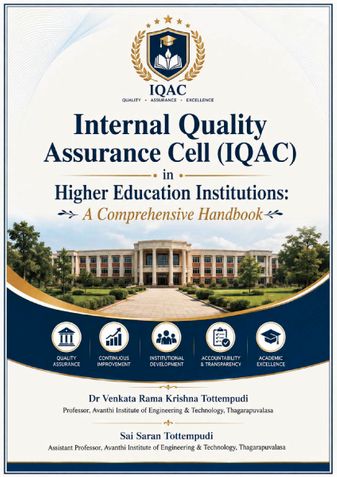
Internal Quality Assurance Cell (IQAC) in Higher Education Institutions: A Comprehensive Handbook (eBook)
Type:
e-book
Genre: Self-Improvement
Language: English
Price:
₹200
(Immediate Access on Full Payment)
Description
Internal Quality Assurance Cell (IQAC) in Higher Education Institutions: A Comprehensive Handbook presents a systematic, practical, and comprehensive framework for understanding, establishing, strengthening, and sustaining quality assurance mechanisms in Higher Education Institutions (HEIs). In an increasingly competitive and rapidly changing higher education environment, institutional quality can no longer be viewed merely as compliance with regulatory requirements or preparation for accreditation. It requires the development of a continuous culture of quality in which academic excellence, effective governance, student success, research and innovation, stakeholder satisfaction, institutional accountability, digital transformation, inclusiveness, and sustainable development are integrated into the everyday functioning of an institution. The Internal Quality Assurance Cell (IQAC) serves as a critical institutional mechanism for facilitating this transformation by coordinating quality-related activities, documenting institutional practices, monitoring performance, identifying gaps, promoting corrective actions, and supporting continuous improvement. This handbook is designed to provide institutional leaders, IQAC coordinators, faculty members, administrators, accreditation teams, researchers, and quality professionals with a structured reference for developing an effective and sustainable IQAC system.
The handbook begins by establishing the conceptual foundations of quality assurance in higher education. It explains the meaning, scope, objectives, principles, evolution, and significance of internal quality assurance and examines the transition from traditional quality-control approaches toward continuous quality enhancement. Particular attention is given to the role of IQAC in creating an institutional quality culture in which planning, implementation, assessment, review, feedback, corrective action, and improvement operate as a continuous cycle. The handbook emphasizes that quality assurance should be integrated with institutional vision, mission, strategic planning, academic development, administrative processes, research priorities, student support systems, and community engagement rather than functioning as an isolated accreditation activity.
A major focus of the handbook is the establishment and governance of IQAC. It discusses the composition, roles, responsibilities, reporting relationships, coordination mechanisms, meeting procedures, documentation practices, and operational responsibilities of IQAC. The role of the Head of the Institution, IQAC Coordinator, faculty members, administrative personnel, students, alumni, employers, and other stakeholders is examined in relation to institutional quality enhancement. The handbook also provides practical approaches for developing IQAC committees, quality policies, annual plans, quality calendars, institutional quality objectives, key performance indicators (KPIs), and monitoring mechanisms. It highlights the importance of leadership commitment, participatory governance, transparency, evidence-based decision-making, and accountability for effective IQAC functioning.
The handbook provides extensive coverage of academic quality assurance, including curriculum design and revision, outcome-based education (OBE), competency development, teaching-learning processes, innovative pedagogies, student-centric learning, assessment and evaluation, continuous internal assessment, examination reforms, rubrics, feedback systems, and Course Outcome (CO) attainment. It explains how academic processes can be systematically monitored through academic audits, course files, lesson plans, teaching-learning records, student performance analysis, and attainment reports. The integration of Programme Outcomes (POs), Programme Specific Outcomes (PSOs), Course Outcomes (COs), and assessment practices is presented as an important component of institutional quality enhancement.
Another important dimension addressed in the handbook is research, innovation, consultancy, and faculty development. The role of IQAC in promoting research culture, publications, patents, funded projects, consultancy, collaborations, intellectual property, innovation activities, entrepreneurship, and interdisciplinary research is discussed. Faculty quality enhancement is addressed through Faculty Development Programmes (FDPs), training, workshops, seminars, professional certifications, industry interaction, academic collaborations, and continuous professional development. The handbook emphasizes the importance of using measurable indicators and documentary evidence to assess the effectiveness of these initiatives.
The handbook also focuses on student support and progression, recognizing students as the primary beneficiaries of higher education. It covers mentoring, scholarships, student welfare, career guidance, placement support, internships, training, entrepreneurship, alumni engagement, grievance redressal, counselling, student feedback, progression to higher education, and employment outcomes. Particular emphasis is placed on systematic collection and analysis of stakeholder feedback and the conversion of feedback into measurable corrective and preventive actions.
A dedicated section examines infrastructure, learning resources, digital transformation, and institutional support systems. The handbook discusses libraries, laboratories, classrooms, information and communication technologies, learning management systems, institutional ERP systems, digital repositories, e-resources, virtual learning environments, and other technology-enabled academic and administrative services. It highlights how digital tools can strengthen evidence collection, data management, KPI monitoring, reporting, feedback analysis, and institutional decision-making while improving transparency and operational efficiency.
The handbook provides detailed guidance on NAAC accreditation and IQAC-related documentation, including the preparation of the Self-Study Report (SSR), Annual Quality Assurance Report (AQAR), supporting documents, evidence collection, data validation, institutional best practices, quality initiatives, academic and administrative audits, stakeholder feedback, and action-taken reports. It explains the importance of maintaining organized, authentic, verifiable, and easily retrievable evidence. The emphasis is on developing documentation systems throughout the year rather than attempting to reconstruct evidence immediately before an accreditation exercise.
The relationship between IQAC and institutional rankings and benchmarking is also explored. The handbook explains how quality-assurance systems can support institutional performance in frameworks such as NIRF, QS, Times Higher Education, India Today rankings, and other relevant national and international benchmarking exercises. It encourages institutions to develop KPI dashboards, data-driven monitoring systems, benchmarking practices, and evidence-based strategic interventions.
The handbook further addresses quality enhancement through best practices, sustainability, inclusiveness, and stakeholder engagement. It encourages institutions to identify, document, evaluate, replicate, and continuously improve innovative practices. Alignment with the Sustainable Development Goals (SDGs), environmental responsibility, social inclusion, gender sensitivity, accessibility, community engagement, and responsible institutional governance are presented as important dimensions of contemporary quality assurance.
A practical orientation is maintained throughout the handbook through checklists, templates, formats, sample reports, KPI frameworks, feedback mechanisms, action plans, audit formats, documentation guidelines, case studies, and frequently asked questions. These resources are intended to help institutions translate quality-assurance principles into operational practices. The handbook promotes the Plan–Do–Check–Act (PDCA) philosophy as a continuous improvement mechanism and encourages institutions to use evidence and measurable outcomes to evaluate the effectiveness of their interventions.
Overall, Internal Quality Assurance Cell (IQAC) in Higher Education Institutions: A Comprehensive Handbook presents IQAC as a strategic institutional instrument for achieving academic excellence, institutional effectiveness, stakeholder satisfaction, accreditation readiness, and sustainable development. Rather than treating quality assurance as a periodic compliance exercise, the handbook advocates a proactive and continuous approach based on planning, participation, evidence, assessment, reflection, innovation, and improvement. It is intended to serve as both a conceptual guide and a practical institutional toolkit for developing robust quality systems and building a sustainable culture of quality and continuous improvement in higher education institutions.
About the Authors
Book Details
Publisher: Self
Number of Pages: 1521
Availability:
Available for Download (e-book)
Ratings & Reviews
Internal Quality Assurance Cell (IQAC) in Higher Education Institutions: A Comprehensive Handbook
Review This Book
Write your thoughts about this book.

Currently there are no reviews available for this book.
Be the first one to write a review for the book Internal Quality Assurance Cell (IQAC) in Higher Education Institutions: A Comprehensive Handbook.
Other Books in Self-Improvement

GrowGlia

SHANKAR S. AAMBURE

Pranav Kumar pandey

LivingInWellbeing, Dr. Purushothaman