You can access the distribution details by navigating to My pre-printed books > Distribution
Add a Review
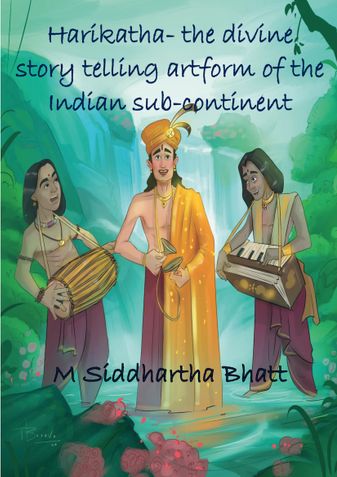
Harikatha- the divine story telling artform of the Indian sub-continent (eBook)
Harikatha
Type:
e-book
Genre: Performing Arts
Language: English
Price:
₹200
(Immediate Access on Full Payment)
Description
This book describes the ancient oral art form of Harikatha (the story of Lord Hari), its origin, presenting format, sister art forms across the Indian sub-continent, components and performatics. The focus is on Harikatha of the Southern Region of India (Dakshinadi Harikatha) and in particular Harikatha as it is presented in the Kannada language (Karnataka Harikatha).
The first Chapter gives an introduction of what is Harikatha, its origin, etymology, historical origin, influences of other arts, forms and formats, people who contributed during in the course of its development and who are presently furthering this art form.
The second Chapter reviews the Pan-Indian and Indian continental art forms. The evolution of storytelling in India, narratology, intertextuality, oral tradition and orature, genres of stories is presented. Among the art forms of the Indian sub-continent, Dastangoi, Bharat of Nepal and lower Himalayan foothills, Swaang, Pandavani, Kalahandi, Chakyar Koothu are included. Aspects of music associated with this art form: ragas, talas, prosodic meters and musical instruments, are covered.
The components covered in the third Chapter are the enacting stage, structure, storyline, classification of Harikatha stories, literary and performance texts, dynamic and evolutionary nature of characters, semiotics and semiosis, oratory, songs, slokas/hymns.
The fourth Chapter is devoted to Performatics: aspects of performance. Production, overall structure, performance configuration, expression, expertise, skillset, themes, triple iterative format of oratory/song/hymn and audience interaction. A few case studies are given towards the end of the Chapter.
The rest of the chapters, viz., Chapter 5 to 8 are in the form of annexures as these are more of the nature of catalogues and archiving rather than running material. Annexure 1 (Chapter 5) traverses across a list of performing artists during the recorded history of this art form. The Annexure 2 (Chapter 6) attempts to list the episodes, Annexure 3 (Ch. 7) gives glossaries of Harikatha terminologies and uttarangas (suffixes) used in the titles. Annex 4 (Ch. 8) gives a limited Kannada dictionary of words and phrases.
The book contains around 4 equations, 55 figures and 17 tables. Besides there are around 40 pictorial illustrations. The book contains around 107 references and around 2200 meanings in vernacular terms.
About the Author
Book Details
ISBN: 9789334571462
Publisher: Self
Number of Pages: 403
Availability:
Available for Download (e-book)
Ratings & Reviews
Harikatha- the divine story telling artform of the Indian sub-continent
Review This Book
Write your thoughts about this book.

Currently there are no reviews available for this book.
Be the first one to write a review for the book Harikatha- the divine story telling artform of the Indian sub-continent.
Other Books in Performing Arts

RANJITHAM P

Kharag Singh, Prof Surjit Singh

Georgica's World

Dr Rajeswari Chellaiah M.A. M.Phil. Ph.D.