You can access the distribution details by navigating to My pre-printed books > Distribution
Add a Review
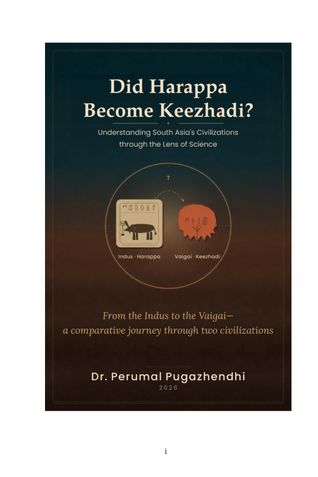
Did Harappa Become Keezhadi? (eBook)
Type:
e-book
Genre: History
Language: English
Price:
₹250
(Immediate Access on Full Payment)
Description
Prologue
A civilization before and after its soil begins to speak
The land carries memories. Rivers write stories along their banks. Traces of lives long past wait quietly in every plowed field and wind-worn mound, until someone comes to read them.
Before the Keezhadi excavations, sites such as Adichanallur, Ari-kamedu, Kodumanal, and Alagankulam had already yielded material evidence of settlement, craftwork, trade, and writing in early Ta-milakam. Sangam poetry preserved literary memories of cities, ports, kings, merchants, love, and war. Keezhadi adds detailed new evidence of settlement life in the Vaigai Valley to this wider record.
Keezhadi has yielded fired-brick structures, black-and-red ware, iron objects, beads, and inscribed pottery sherds. According to the 2019 state report, 56 sherds bearing Tamil-Brahmi inscriptions were recorded in the fourth excavation phase; later phases found more. These finds show that writing appeared on everyday vessels. The num-ber of sherds alone, however, cannot prove that literacy was wide-spread across the population.
These discoveries also raise a new question. Around 2600 BCE, one of the world’s earliest great urban civilizations flourished in the Indus Valley: Harappa. How was it related to Keezhadi? Was Keezhadi a con-tinuation or descendant of Harappa, or did it grow independently from its own roots? This question lies at the heart of the book.
Slogans cannot answer it; evidence can. This book therefore reads soil layers, dates organic remains with radiocarbon methods, compares pottery and inscriptions, and examines the story told by ancient DNA. At every step, it separates what we know from what we infer and what we still do not know. The willingness to say “we do not know” is part of scientific honesty.
I wrote this book for readers of all ages. I want a school student, a university student, and an older farmer alike to understand the evi-dence without losing its scientific rigor. The way people understand their past shapes the way they understand themselves. That under-standing should rest on evidence, not legend. This book neither exag-gerates nor diminishes Tamil antiquity. Keezhadi’s importance does not depend on proving a direct link to Harappa.
Keezhadi and Harappa: two remarkable archaeological worlds, two river valleys, and a shared human heritage. This book unfolds the question of their relationship carefully, one step at a time. The journey begins here
About the Author
Book Details
ISBN: 9798905047725
Publisher: Primedia eLaunch LLC
Number of Pages: 113
Availability:
Available for Download (e-book)
Ratings & Reviews
Did Harappa Become Keezhadi?
Review This Book
Write your thoughts about this book.

Currently there are no reviews available for this book.
Be the first one to write a review for the book Did Harappa Become Keezhadi?.
Other Books in History

Amol Mahajan

Divyanshu Verma
SAIKAT DASGUPTA

Richard Denham