You can access the distribution details by navigating to My pre-printed books > Distribution

Add a Review
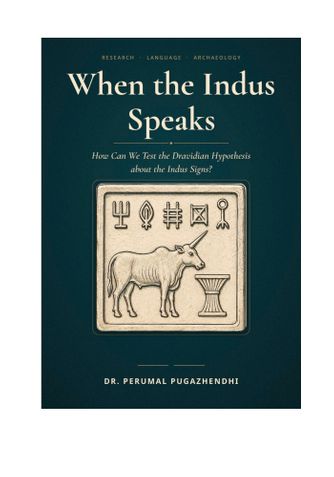
When the Indus Speaks (eBook)

How Can We Test the Dravidian Hypothesis about the Indus Signs?
Type: e-book
Genre: History
Language: English
Price: ₹250
(Immediate Access on Full Payment)
Available Formats: PDF

Description

Harappa Pesumbothu (When the Indus Speaks), by Dr. Perumal Pugazhendhi, explores a fascinating question about South Asia's past: could the Indus signs have recorded an early Dravidian language, and could traces of that language survive in Tamil and related languages? Written in Tamil, the book invites readers to examine this possibility through archaeology, linguistics, chronology, and scientific testing.

Across sixteen chapters, readers travel from the cities, seals and trade networks of the Harappan world to the history of Tamil and the archaeological discoveries of southern India. Keezhadi, Porunai, early iron technology, Tamil-Brahmi inscriptions and pottery graffiti form part of this discussion. The book considers what each source can reveal and what further evidence a proposed connection would require.

The argument is organized around five hypotheses: an early Dravidian language in the Harappan world; patterns in the arrangement of Indus signs; the possible survival of ancient words; cultural continuity; and the movement and interaction of people toward the south. The author's E1-E5 evidence ladder helps readers distinguish established findings, strong reconstructions, working hypotheses and preliminary speculation.

At the heart of the book is an examination of the signs themselves. Repeated endings, sign order, number groups and archaeological contexts are considered before possible words or sounds are assigned. Proposed readings such as mīn?, ūr?, nīr?, kal? and āḷ? open questions about fish, settlements, water, stone and people. Their question marks identify them as tentative readings. Each proposal is linked to predictions, alternative explanations and conditions that could weaken it.

The discussion of migration gives attention to the societies already living in southern India. Possible movement through Gujarat and the Deccan is explored as a process of contact and interaction with established local communities. Ancient DNA contributes to questions about ancestry and population history, while the language spoken by those populations requires its own evidence. This distinction keeps biological, cultural and linguistic claims clear.

Pottery graffiti and Indus signs are examined through four tests: similarity of form, patterns of use within sign sequences, a dated chain of intermediate evidence and the context of the objects carrying the marks. Together, these tests provide a way to assess suggestions of continuity. The comparison with Tamil-Brahmi also separates a possible language relationship from a proposed direct ancestry between writing systems.

Illustrations, comparative tables, timelines, a glossary and a bibliography guide readers through the material. Eleven appendices extend the discussion with a tentative sign dictionary, twenty-five published predictions, reader checklists, measurement procedures, research plans, ICIT sign plates and Tamil-Brahmi reference forms. An appendix presents author-reported pilot counts of final signs and explains the limits of their verification and the need for independent replication.

For Tamil readers around the world, students and anyone interested in ancient South Asia, this book offers a way to explore a historical question with curiosity and care. Its central principle is simple: cultural attachment can inspire the inquiry, while evidence must determine the conclusion. The reader is invited to follow the arguments, question the proposals and take part in a search for the past.

About the Author

Dr. Perumal Pugazhendhi is a senior energy and materials scientist with more than 40 years of experience. His fields are advanced materials, renewable ener-gy, electrochemical energy storage, hydrogen technologies, and environmental engineering.
His research reaches across many fields: fuel cells, advanced batteries, ionic liquids, hydrogen production and storage, solar thermal technologies, carbon-based materials, nanotechnology, multifunctional composites, and sustainable engineering systems. In his work he has joined basic materials research with building prototypes and testing how well they perform. Turning ideas from the laboratory into practical technologies is also part of what he does.
He has led many research and technology development projects as Principal Investigator, with support from NASA, the US Department of Energy, and the US Department of Defense. These include Small Business Innovation Research (SBIR) and Small Business Technology Transfer (STTR) projects. His work has not stopped at academic research. He has also been active in applied research, prototype engineering, and bringing technology to market, and he has worked alongside government agencies, universities, and industry partners.
He has served as a Brain Pool scientist at the Korea Institute of Energy Re-search, as a visiting scientist at the Norwegian University of Science and Tech-nology (NTNU), and as a visiting young scientist at the University of Barcelona. He has also worked with researchers and institutions in several countries, in-cluding the University of Arizona in the United States.
An inventor and a scholar, he holds several patents and has written more than 50 peer-reviewed scientific papers. As a Fellow of the Society for the Ad-vancement of Science and Technology, India, and as a reviewer for professional journals, he has contributed to the international scientific community.
A Tamil living in the United States, he has a deep interest in Tamil language, literature, history, archaeology, and technological heritage. The discoveries at Keezhadi and at other archaeological sites in Tamil Nadu led him to explore how scientific methods might help the public understand the Tamil past. His aim is not to replace the specialist work of archaeologists, historians, epigraphers, and linguists. His aim is to bring together the evidence they have gathered and present it to general readers in an orderly way that is easy to follow. He believes that cultural pride and scientific fairness can strengthen each other.
In When the Indus Speaks, he does not treat the Dravidian hypothesis about the Indus script as a cultural belief. Nor does he treat it as a conclusion decided in advance. He approaches it as a research question that can be tested. There are many kinds of evidence: the structure of the signs, comparison between lan-guages, words that survive in Old Tamil and other Dravidian languages, South Indian archaeology, cultural continuity, and the meeting of peoples. He does not blend these into evidence for a single conclusion. He judges each claim on its own, with the burden of evidence that belongs to it.
This book does not announce in advance that “the Harappan language was Tamil.” The idea that an early Dravidian language may have been linked to the Indus script is a hypothesis. This book puts forward a research framework for testing that hypothesis properly. Evidence for it and evidence against it must be judged by the same standard. That is the author’s scientific position.
His central principle is simple:
“Cultural attachment may prompt the question, but evidence must de-cide the answer.”
Scholars, researchers, and readers are free to criticize, with an open mind, the hypotheses, methods of measurement, predictions, and tests of refutation that this book puts forward. The author welcomes that kind of engagement.
Disclaimer
This book is meant for education and research. The proposed readings of Indus signs are not established translations. The question mark signals exactly that. They should be read alongside the original inscription records, sign lists, exca-vation reports, and the studies cited.
The numbers in Appendix K come from a reported preview study. Checking the arithmetic of the printed table is no substitute for an independent replication from the original data. This edition keeps that difference in plain view.
The conclusions of this book may be revised if new evidence comes to light, if errors are pointed out, or if other explanations are put forward. For that pur-pose, the author welcomes criticism and independent tests.
The responsibility for any remaining errors and interpretations is the au-thor’s alone.

Book Details

ISBN: 9798906009500
Publisher: Primedia eLaunch LLC
Number of Pages: 261
Availability: Available for Download (e-book)

Ratings & Reviews

When the Indus Speaks

When the Indus Speaks

(Not Available)

Review This Book

Write your thoughts about this book.

Currently there are no reviews available for this book.

Be the first one to write a review for the book When the Indus Speaks.

Other Books in History
Shop with confidence

Safe and secured checkout, payments powered by Razorpay. Pay with Credit/Debit Cards, Net Banking, Wallets, UPI or via bank account transfer and Cheque/DD. Payment Option FAQs.