You can access the distribution details by navigating to My pre-printed books > Distribution
Add a Review
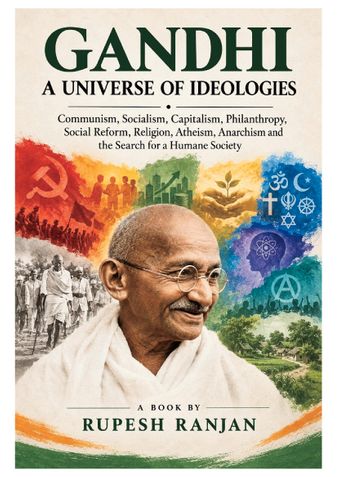
GANDHI: A UNIVERSE OF IDEOLOGIES (eBook)
Communism, Socialism, Capitalism, Philanthropy, Social Reform, Religion, Atheism, Anarchism and the Search for a Humane Society
Type:
e-book
Genre: Philosophy, History
Language: English
Price:
₹168
(Immediate Access on Full Payment)
Description
Gandhi: A Universe of Ideologies
Communism, Socialism, Capitalism, Philanthropy, Social Reform, Religion, Atheism, Anarchism and the Search for a Humane Society
Author: Rupesh Ranjan
Mahatma Gandhi was far more than a political leader or the principal symbol of India's struggle for independence. He was a moral philosopher, social reformer, spiritual seeker and political experimenter whose ideas challenged conventional understandings of power, wealth, religion, freedom and human progress. His life raised questions that continue to confront societies across the world: Can economic equality be achieved without hatred? Can political freedom exist without moral responsibility? Can religion promote universal compassion rather than division? Can resistance transform injustice without reproducing the violence it seeks to overcome?
Gandhi: A Universe of Ideologies explores these questions by examining Gandhi's philosophy in relation to some of the most influential political, economic, social and spiritual traditions in human history. Across twenty-eight chapters, the book investigates his engagement with communism, socialism, capitalism, philanthropy, social reform, religion, atheism, anarchism, democracy, environmental responsibility and non-violent resistance.
Rather than presenting Gandhi as a literal follower of every ideology, the book examines the points at which his thought converged with, challenged or departed from these traditions. His commitment to economic justice invites comparison with socialism and communism, while his concept of trusteeship raises difficult questions about private property, wealth and the responsibilities of economic power. His emphasis on self-rule and decentralized authority offers connections with anarchist thought, yet his understanding of freedom was inseparable from self-discipline, mutual responsibility and ethical conduct.
The book also explores Gandhi's religious and philosophical outlook, particularly his understanding of truth, non-violence, conscience, spiritual discipline and religious pluralism. It considers whether ethical responsibility can transcend religious belief and how a diverse society can protect both freedom of faith and freedom of non-belief. His social reform efforts are examined alongside his disagreements with Dr. B. R. Ambedkar, especially concerning caste, untouchability, political representation and the meaning of social equality.
Importantly, this work does not approach Gandhi through uncritical admiration. It recognises the contradictions, historical limitations and unresolved questions within his philosophy. Gandhi's views on caste, his economic idealism, his relationship with modern industrial civilisation and the practical difficulties of translating moral principles into public institutions deserve careful scrutiny. His legacy becomes more meaningful when admiration is accompanied by historical evidence, intellectual honesty and a willingness to question.
The book further examines Gandhi's relevance to contemporary challenges, including economic inequality, consumerism, environmental degradation, political polarization, technological change and the erosion of public trust. It asks whether truth, non-violence, simplicity, decentralized participation and moral accountability can contribute to a more humane future without ignoring the need for constitutional safeguards, institutional reform and structural justice.
At its heart, Gandhi: A Universe of Ideologies argues that Gandhi's enduring significance does not lie in his belonging to every ideological tradition. It lies in his persistent effort to judge systems of power and belief by their consequences for human dignity, freedom, justice and collective well-being.
This is neither an attempt to place Gandhi above criticism nor an effort to confine him within a single political label. It is an invitation to encounter Gandhi as a complex human being whose ideas remain open to interpretation, disagreement and renewal.
By bringing together competing ideologies through the lens of Gandhian thought, Rupesh Ranjan seeks to encourage a broader conversation about the moral foundations of society. The ultimate question is not simply which ideology Gandhi represented, but whether the ideologies we embrace can help create a world in which truth is respected, exploitation is challenged, diversity is protected and humanity remains greater than the systems it creates.
About the Author
Book Details
Number of Pages: 618
Availability:
Available for Download (e-book)
Ratings & Reviews
GANDHI: A UNIVERSE OF IDEOLOGIES
Review This Book
Write your thoughts about this book.

Currently there are no reviews available for this book.
Be the first one to write a review for the book GANDHI: A UNIVERSE OF IDEOLOGIES.
Other Books in Philosophy, History

Rishi Raj

Aariz Menon

Sunil Khandbahale

Durga Prasad