You can access the distribution details by navigating to My pre-printed books > Distribution
Add a Review
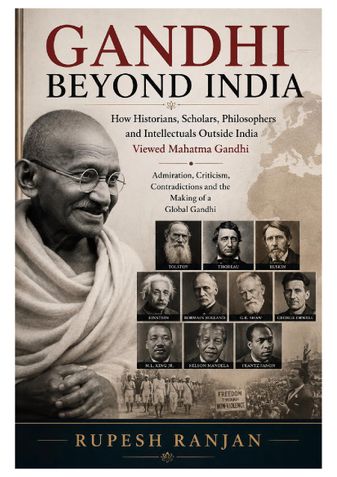
GANDHI BEYOND INDIA (eBook)
How Historians, Scholars, Philosophers and Intellectuals Outside India Viewed Mahatma Gandhi Admiration, Criticism, Contradictions and the Making of a Global Gandhi
Type:
e-book
Genre: Politics & Society, Exam Preparation
Language: English
Price:
₹211
(Immediate Access on Full Payment)
Description
GANDHI BEYOND INDIA
How Historians, Scholars, Philosophers and Intellectuals Outside India
Viewed Mahatma Gandhi
Gandhi Beyond India is an original and deeply analytical exploration of how Mahatma Gandhi was
understood, interpreted, admired, questioned and criticized beyond the geographical and intellectual
boundaries of India.
Gandhi occupies a remarkable position in modern world history. He was an Indian nationalist, an
advocate of non-violent resistance, a religious thinker, a social reformer, an economic critic, a
political organizer and, eventually, a global moral symbol. Yet the Gandhi remembered outside India
has often been different from the Gandhi encountered in Indian political and historical debates.
European philosophers, American intellectuals, British imperial officials, pacifists, socialists,
Marxists, anti-colonial revolutionaries, civil-rights leaders, feminists, environmental thinkers and
contemporary political philosophers have each constructed their own interpretations of him.
This book studies that international Gandhi.
It does not attempt to write another conventional biography of Gandhi. Instead, it examines the
intellectual journey through which Gandhi became a global figure. It asks how people outside India
encountered his ideas, why some regarded him as one of the most important moral figures of the
twentieth century, why others considered him politically unrealistic or socially conservative, and
why his contradictions have remained a source of scholarly debate.
At the heart of the book is a simple but important distinction: Gandhi the historical individual is not
always identical to Gandhi the global symbol.
The Gandhi of international imagination has sometimes been transformed into an almost universal
figure representing peace, compassion, civil resistance and moral courage. Yet the historical Gandhi
was considerably more complicated. He changed his political positions, experimented with ideas,
struggled with questions of violence and morality, maintained evolving views concerning empire and
nationalism, criticized modern industrial civilization, developed distinctive economic ideas and held
positions on caste, gender, sexuality and religion that continue to generate serious debate.
Understanding Gandhi therefore requires moving beyond both unquestioning admiration and
simplistic rejection.
This book deliberately brings together both sides.
It explores the admiration of thinkers such as Leo Tolstoy, Albert Einstein, Romain Rolland and
George Bernard Shaw, while also examining critical interpretations associated with figures such as
George Orwell and Winston Churchill and broader Marxist, postcolonial, feminist and contemporary
scholarly traditions.
The book also investigates Gandhi's intellectual relationship with Western thinkers such as Henry
David Thoreau and John Ruskin, whose ideas formed part of the intellectual environment from
which Gandhi developed some of his distinctive arguments concerning resistance, morality, labour, simplicity and civilization.
One of the major themes of the book is Gandhi's philosophy of ahimsa and satyagraha. International
observers frequently interpreted these concepts through their own intellectual traditions. To some,
Gandhi represented pacifism. To others, he represented something more active: organized resistance
through discipline, courage, sacrifice and mass participation. The distinction is important. Gandhi's
method was not simply refusal to fight; it was an attempt to transform resistance itself into a moral
and political force.
The book consequently asks difficult questions.
Was Gandhi a pacifist or a revolutionary?
Was satyagraha primarily an ethical philosophy or a political technology?
Was Gandhi opposed to Western civilization or merely opposed to particular forms of modernity?
Was his economic thought an impractical return to village life or an early critique of unlimited
consumption?
Did his religious worldview strengthen his politics or impose limitations upon it?
Did his campaign against untouchability adequately challenge the deeper structure of caste?
Did Gandhi empower women while simultaneously imposing demanding moral expectations upon
them?
Could non-violent resistance succeed against every form of political oppression?
And perhaps most importantly, can Gandhi's moral philosophy be separated from the historical
circumstances in which it developed?
These questions make Gandhi an unusually important subject for international intellectual history.
The book also examines the remarkable afterlife of Gandhian thought. Gandhi's influence did not end
with Indian independence or his assassination. His ideas travelled across continents and entered
different political environments. Martin Luther King Jr. creatively adapted elements of Gandhian
thought to the American civil-rights struggle. Anti-colonial movements and activists around the
world encountered his methods, sometimes embracing them and sometimes rejecting them in favour
of revolutionary violence. Later environmental thinkers found inspiration in his criticism of
excessive consumption and industrial civilization. Contemporary scholars continue to debate his
relevance to democracy, civil disobedience, political obligation, social justice and resistance.
Yet influence should not be confused with imitation.
The Gandhi encountered by Martin Luther King Jr. was not necessarily identical to the Gandhi
interpreted by European pacifists. The Gandhi discussed by environmental thinkers is not necessarily
the same Gandhi criticized by Marxists. The Gandhi celebrated by international institutions may
differ significantly from the Gandhi examined by feminist or postcolonial scholars.
There are therefore many Gandhis in international intellectual history.
This book attempts to understand them.
Its method is deliberately comparative and critical. It distinguishes, wherever possible, between what
Gandhi himself argued, what foreign observers believed about him, and what later scholars
concluded about those arguments. This distinction is essential because historical reputations are
rarely created by one person alone. They are constructed through biographies, newspapers, political
speeches, academic studies, films, photographs, textbooks, commemorations and movements that reinterpret historical personalities for new generations.
The making of the global Gandhi was therefore also a process of interpretation and reconstruction.
Another central purpose of the book is to challenge the idea that Gandhi must either be accepted
completely or rejected completely.
Great historical figures rarely fit such categories.
Gandhi's importance does not require perfection. Indeed, one reason he continues to attract serious
scholarship is precisely because his moral ambition existed alongside political and intellectual
contradictions. His critics have identified genuine problems in his thinking, while his admirers have
identified genuine innovations in political resistance and ethical leadership.
Both observations can coexist.
A mature historical understanding does not ask whether Gandhi was simply a saint or a villain. It
asks what he attempted to accomplish, why his ideas emerged, why they influenced millions, where
they succeeded, where they failed, and what their limitations reveal about the relationship between
morality and politics.
Gandhi Beyond India is therefore not a book of celebration, nor is it a book of demolition.
It is a book of intellectual examination.
Its broader argument is that Gandhi became a global intellectual figure because he confronted some
of the deepest problems of modern political life. He challenged the assumption that political
effectiveness necessarily required physical violence. He questioned the idea that economic progress
should be measured only through production and consumption. He criticized forms of modern
civilization that separated material advancement from moral responsibility. He attempted to place
conscience at the centre of political action. At the same time, his own life demonstrated how difficult
it is to translate absolute moral aspirations into the complicated realities of politics, society and
human relationships.
That tension is central to understanding his international reputation.
The book ultimately presents Gandhi as neither an untouchable icon nor an easily dismissible
historical personality. It presents him as a contested global thinker whose ideas travelled across
cultures precisely because they generated questions that extended far beyond India.
His legacy belongs not only to those who admire him.
It also belongs to those who question him.
And perhaps that is the most enduring meaning of Gandhi beyond India: not a finished answer to the
problems of politics and morality, but an unfinished intellectual conversation about how human
beings should resist injustice, exercise power, pursue freedom and live with one another.
This book invites the reader into that conversation.
About the Author
Book Details
Number of Pages: 799
Availability:
Available for Download (e-book)
Ratings & Reviews
GANDHI BEYOND INDIA
Review This Book
Write your thoughts about this book.

Currently there are no reviews available for this book.
Be the first one to write a review for the book GANDHI BEYOND INDIA.
Other Books in Politics & Society, Exam Preparation
KIRAN VEMALA

Created by : Devesh gupta 'SIR'

MANIK JOSHI

D. Abraham