You can access the distribution details by navigating to My pre-printed books > Distribution
Add a Review
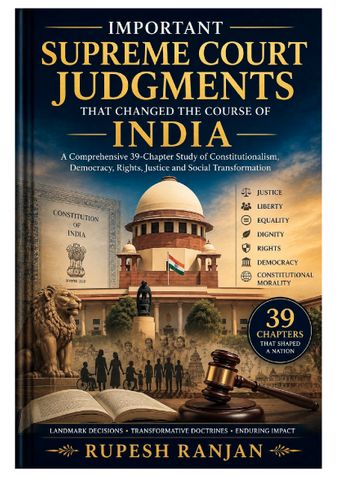
Important Supreme Court Judgments That Changed the Course of India (eBook)
A Comparative Study of Two Transformative Thinkers of Modern India
Type:
e-book
Genre: Law, Politics & Society
Language: English
Price:
₹231
(Immediate Access on Full Payment)
Description
Important Supreme Court Judgments That Changed the Course of India
A Comprehensive 39-Chapter Study of Constitutionalism, Democracy, Rights, Justice and Social Transformation
India's constitutional journey is also a journey through its courts. Since the Constitution came into force, the Supreme Court of India has interpreted constitutional provisions, protected fundamental rights, reviewed governmental action, settled institutional conflicts, and responded to some of the most difficult social and political questions of the country. Its judgments have not merely resolved individual disputes; many have influenced the direction of Indian democracy and the meaning of constitutional citizenship.
Important Supreme Court Judgments That Changed the Course of India is a comprehensive 39-chapter study of landmark decisions that have shaped India's constitutional, democratic, social and institutional development. The book traces the evolution of Indian constitutional jurisprudence from the early years of the Republic to the contemporary era of privacy, technology, gender justice, identity, electoral transparency and constitutional morality.
Beginning with A.K. Gopalan, Shankari Prasad, Sajjan Singh and Golaknath, the book follows the constitutional struggle over Parliament's power to amend the Constitution and culminates in the historic Kesavananda Bharati decision and the Basic Structure Doctrine. It then examines the constitutional crises of the Emergency through Indira Gandhi v. Raj Narain and ADM Jabalpur, followed by the transformative understanding of personal liberty established in Maneka Gandhi and strengthened through Minerva Mills and Waman Rao.
The book also explores the Supreme Court's contribution to federalism, secularism and democratic governance through cases such as S.R. Bommai, the anti-defection framework in Kihoto Hollohan, and the reservation and equality jurisprudence of Indra Sawhney. It examines the expansion of fundamental rights through Olga Tellis, Bandhua Mukti Morcha, the environmental jurisprudence associated with M.C. Mehta, Vishaka, D.K. Basu, and the end-of-life questions raised in Aruna Shanbaug and Common Cause.
A significant part of the book focuses on the constitutional recognition of identity, autonomy and individual choice. The decisions in NALSA, Shafin Jahan, Navtej Singh Johar, Joseph Shine and Shayara Bano demonstrate how constitutional values have been applied to questions of gender identity, marriage, sexuality, equality, personal autonomy and religious practice.
The digital age receives particular attention through Justice K.S. Puttaswamy, which recognised privacy as a fundamental right, the constitutional litigation surrounding Aadhaar, and Shreya Singhal, which became a landmark decision concerning freedom of speech on the internet. These cases reveal how constitutional principles must continually respond to technological change and new forms of state and private power.
The book further examines electoral democracy and institutional accountability, including Vineet Narain, PUCL, Association for Democratic Reforms, and the NJAC judgment. It considers the continuing constitutional debates surrounding investigative independence, the voter's right to know, transparency in elections, judicial appointments and judicial independence.
The chapters on Ayodhya and Sabarimala explore the difficult relationship between faith, religious freedom, equality, constitutional morality, historical claims and judicial adjudication. Rather than presenting these controversies through a purely political lens, the book approaches them as important constitutional questions requiring careful attention to law, evidence, institutional authority and competing rights.
The concluding chapters move beyond individual judgments to examine the larger ideas of transformative constitutionalism, judicial activism, judicial restraint, social justice and the limits of judicial power. The book asks not simply what individual judgments decided, but what they reveal about the evolving relationship between citizens, courts, legislatures and governments.
At its heart, this book is about the Constitution as a living promise. The judgments discussed here illustrate how liberty, equality, dignity, justice, democracy and institutional accountability have been interpreted across different periods of India's history. They also demonstrate that constitutional democracy is not a finished project. It develops through continuing dialogue, disagreement, interpretation and public engagement.
Written in an independent narrative voice for educational, academic and public-awareness purposes, this book is intended for students, civil-service aspirants, law students, teachers, researchers, writers and general readers interested in India's constitutional development.
It is ultimately an invitation to understand the Supreme Court not merely as an institution that decides cases, but as one of the important arenas in which India's constitutional ideals have been tested, interpreted and transformed.Rupesh Ranjan is an Indian writer, researcher and author whose literary interests span constitutionalism, Indian history, public policy, governance, society, economics, education, culture and contemporary national issues. His writing reflects a sustained interest in understanding India through its institutions, ideas, historical experiences and social transformations.
With an interdisciplinary approach, Ranjan seeks to connect academic subjects with questions that matter to ordinary citizens. His works frequently explore themes such as democracy, the Constitution, social justice, public administration, education, human development, political thought, Indian civilisation and national progress.
As an author, he is particularly interested in presenting complex subjects in an accessible and descriptive manner. His approach combines historical context, conceptual analysis and contemporary relevance, with the objective of encouraging readers to think critically about the institutions and ideas that shape society.
In Important Supreme Court Judgments That Changed the Course of India, Ranjan turns his attention to the Indian judiciary and constitutional development. Through the study of landmark Supreme Court decisions, he examines how constitutional principles such as liberty, equality, dignity, judicial review, federalism, secularism, privacy, democracy and constitutional morality have evolved over time.
The book reflects his broader literary interest in the relationship between law, society and national development. Rather than viewing constitutional judgments merely as technical legal decisions, Ranjan presents them as important milestones in India's continuing democratic journey.
His writing is intended for a diverse readership—including students, researchers, civil-service aspirants, teachers, academics and general readers—and aims to encourage greater public understanding of India's constitutional institutions.
Rupesh Ranjan's literary work is ultimately guided by a simple belief: knowledge becomes meaningful when it helps society understand itself better. Through his books and research-oriented writing, he seeks to contribute to informed public discussion and to the growing body of accessible literature on India, its Constitution, its society and its future.
About the Author
Book Details
Number of Pages: 695
Availability:
Available for Download (e-book)
Ratings & Reviews
Important Supreme Court Judgments That Changed the Course of India
Review This Book
Write your thoughts about this book.

Currently there are no reviews available for this book.
Be the first one to write a review for the book Important Supreme Court Judgments That Changed the Course of India.
Other Books in Law, Politics & Society

இஷாக்

Syed Rizwan

Adv Cherry Kushwaha

Menaka Neotia