You can access the distribution details by navigating to My pre-printed books > Distribution
Add a Review
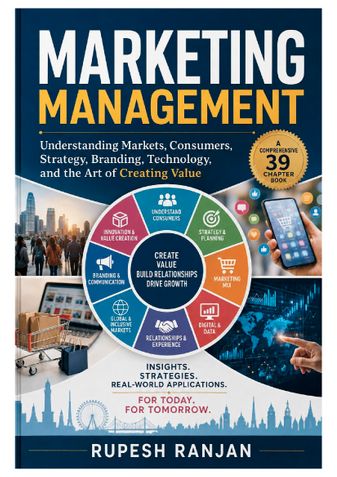
Marketing Management (eBook)
Understanding Markets, Consumers, Strategy, Branding, Technology, and the Art of Creating Value
Type:
e-book
Genre: Business & Economics, Education & Language
Language: English
Price:
₹195
(Immediate Access on Full Payment)
Description
Marketing Management
Understanding Markets, Consumers, Strategy, Branding, Technology,
and the Art of Creating Value
Marketing Management is a comprehensive 39-chapter exploration of one of the most important and
rapidly changing disciplines of modern business. The book examines marketing not simply as the
process of promoting and selling products, but as a broad managerial philosophy concerned with
understanding people, identifying needs, creating value, building relationships, developing brands,
managing markets, and achieving sustainable organizational performance.
In a competitive economy, organizations cannot succeed merely by producing good products. They
must understand what customers value, how markets change, why consumers make particular
choices, how competitors behave, how technology transforms expectations, and how organizations
can create meaningful differences in the minds of their customers. Marketing management brings
these dimensions together into a systematic framework for managerial decision-making.
The book begins with the foundations of marketing, explaining its meaning, nature, scope, evolution,
objectives, functions, and relationship with selling, advertising, and promotion. It then examines
marketing management as an organizational process involving planning, implementation,
coordination, control, research, and strategic decision-making.
A major focus is placed on understanding customers and markets. Consumer behavior is examined
from psychological, social, cultural, personal, and economic perspectives. The book explores
customer needs, wants, demand, expectations, perceived value, satisfaction, loyalty, and customer
experience. It also examines business-to-business markets and organizational buying behavior,
recognizing that marketing decisions differ substantially between consumer and industrial markets.
The book provides detailed treatment of segmentation, targeting, and positioning, showing how
organizations can identify distinct groups of customers, select attractive markets, and develop
meaningful positions. These concepts provide the foundation for building focused and differentiated
marketing strategies.
The strategic dimension of marketing is explored through strategic planning, competitive analysis,
opportunity identification, forecasting, and marketing-mix decisions. Product, price, place, and
promotion are examined not as isolated tools but as interconnected components of an integrated
strategy.
The book then moves into product management, innovation, branding, and brand equity. It
examines how organizations develop new products, manage product portfolios, respond to different
stages of the product life cycle, build strong brands, establish brand identities, create differentiation,
and undertake brand extensions or rebranding. Packaging, labeling, design, and product presentation
are also examined as important components of the customer experience.
Another major section focuses on pricing, distribution, retailing, and promotion. Pricing is analyzed
as both an economic and psychological decision, while distribution is considered as a mechanism
through which organizations deliver value and make products accessible. The transformation of retail through e-commerce, marketplaces, direct-to-consumer models, and omnichannel systems is also
explored.
Marketing communication receives extensive attention through the study of integrated marketing
communications, advertising, sales promotion, public relations, personal selling, and relationship-
based communication. The objective is to understand how organizations can create consistent,
credible, and persuasive communication across multiple channels.
The book gives particular importance to the digital transformation of marketing. Digital marketing,
social media, influencer marketing, content marketing, search marketing, online customer
acquisition, marketing automation, and digital customer journeys are examined as essential
components of contemporary marketing strategy.
One of the most significant contemporary developments discussed in the book is the growing
importance of data and artificial intelligence. Marketing analytics, predictive analysis, customer
insights, recommendation systems, personalization, automation, and AI-supported decision-making
are examined alongside their limitations and ethical implications.
The book also addresses customer data, privacy, personalization, and marketing technology,
recognizing that the ability to collect and analyze customer information creates both opportunities
and responsibilities. Modern marketers must balance commercial objectives with transparency,
consent, privacy, security, and consumer rights.
Beyond conventional consumer-goods marketing, the book examines services marketing and service
quality, recognizing the importance of customer experiences, employee interactions, service
encounters, expectations, trust, and service recovery. Relationship marketing and customer retention
are explored as essential components of long-term organizational profitability.
The international dimension of marketing is addressed through global marketing, cultural
differences, international segmentation, market-entry strategies, global branding, adaptation,
standardization, and geopolitical uncertainty. The book also gives attention to rural, inclusive, and
emerging markets, emphasizing affordability, accessibility, local culture, infrastructure, and the
needs of underserved consumers.
Marketing cannot be separated from questions of ethics and social responsibility. The book therefore
examines misleading advertising, manipulation, privacy, targeting, dark patterns, consumer
vulnerability, responsible communication, corporate responsibility, sustainable consumption, green
marketing, social marketing, circular economy principles, and the problem of greenwashing.
A further emphasis is placed on marketing performance measurement and control. Organizations
need to determine whether their marketing investments are producing meaningful outcomes. The
book therefore examines sales, market share, customer acquisition cost, retention, conversion,
customer lifetime value, brand performance, return on marketing investment, campaign
measurement, dashboards, and marketing audits.
The final chapters look toward the future of marketing management. Artificial intelligence,
immersive technologies, conversational commerce, creator economies, automation, personalization,
experiential marketing, privacy-first approaches, and changing consumer identities are considered as
forces that may reshape marketing in the coming years.
At the heart of the book is a simple but powerful idea:
Marketing is not merely about selling what an organization produces; it is about understanding what people value and building the capabilities to create, communicate, deliver, and sustain that value.
The book therefore presents marketing as a bridge between organizations and society, products and
people, technology and human judgment, strategy and execution, and commercial objectives and
customer expectations.
Written for students, teachers, managers, entrepreneurs, business professionals, researchers,
administrators, and general readers interested in business and society, this book aims to combine
conceptual understanding with practical managerial thinking.
Ultimately, Marketing Management argues that the strongest organizations of the future will not
necessarily be those that advertise the most aggressively or collect the most data. They will be those
that understand their markets deeply, innovate intelligently, respect their customers, use technology
responsibly, build trustworthy brands, create meaningful experiences, and consistently deliver
genuine value.
Marketing begins with understanding.
It develops through strategy.
It becomes meaningful through value.
And it becomes sustainable through trust.
Author
Rupesh Ranjan
About the Author
Book Details
Number of Pages: 1137
Availability:
Available for Download (e-book)
Ratings & Reviews
Marketing Management
Review This Book
Write your thoughts about this book.

Currently there are no reviews available for this book.
Be the first one to write a review for the book Marketing Management.
Other Books in Business & Economics, Education & Language
BHAVESH POKAR


ESHA SHEIKH

Manas Kalia, Rajat Kalia