You can access the distribution details by navigating to My pre-printed books > Distribution
Add a Review
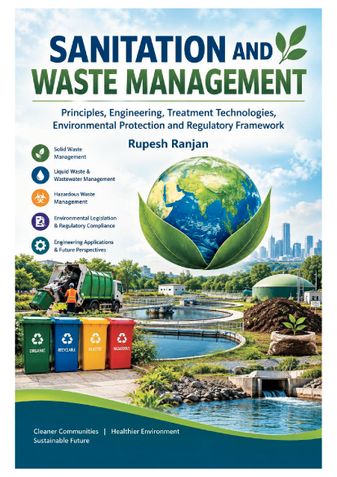
SANITATION AND WASTE MANAGEMENT (eBook)
Principles, Engineering, Treatment Technologies, Environmental Protection and Regulatory Framework
Type:
e-book
Genre: Engineering, Exam Preparation
Language: English
Price:
₹123
(Immediate Access on Full Payment)
Description
Sanitation and waste management are fundamental pillars of public health, environmental
protection, and sustainable development. As populations grow, cities expand, industries evolve, and
patterns of consumption change, the generation of solid waste, wastewater, and hazardous materials
continues to create complex challenges for communities, governments, and environmental
professionals. Managing these challenges requires more than the collection and disposal of waste; it
demands scientific understanding, sound engineering, effective treatment technologies, responsible
resource recovery, strong regulatory institutions, and long-term environmental planning.
Sanitation and Waste Management: Principles, Engineering, Treatment Technologies, Environmental
Protection and Regulatory Framework offers a comprehensive and integrated exploration of the
principles, technologies, practices, and institutional mechanisms that underpin modern sanitation
and waste management. The book brings together environmental engineering, public health,
pollution prevention, waste-treatment systems, resource efficiency, and environmental legislation
within a single, systematically organised framework.
Beginning with the fundamentals of sanitation, waste classification, waste generation, and integrated
management, the book examines the complete lifecycle of municipal solid waste. It explores waste
characterisation, collection, transportation, segregation, recycling, composting, biomethanation,
thermal treatment, energy recovery, and scientific landfill disposal. It emphasises the importance of
reducing waste generation, recovering useful materials, and minimising the environmental impacts
associated with inappropriate handling and disposal.
The book then examines liquid waste and wastewater management, covering water resources,
pollution characteristics, collection systems, preliminary and primary treatment, aerobic and
anaerobic biological processes, advanced treatment technologies, water reclamation, reuse, and
resource recovery. It also addresses groundwater recharge, public-health protection, and wastewater
risk assessment, highlighting the relationship between sanitation infrastructure, water security, and
the prevention of environmental contamination.
Recognising the special risks associated with hazardous materials, the book provides a dedicated
discussion of hazardous waste, biomedical waste, chemical waste, contaminated sites, physical and
chemical treatment processes, and environmental restoration. These subjects are approached through
the principles of hazard identification, risk reduction, safe handling, appropriate treatment, and
scientifically informed decision-making.
A major strength of this work is its attention to environmental legislation and regulatory compliance
in India. It introduces the institutional framework governing environmental protection and discusses
waste-management regulations, environmental monitoring, pollution prevention, enforcement,
environmental impact assessment, environmental clearance, site authorisation, and pollution-control board consents. By connecting legal responsibilities with engineering practice, the book
demonstrates why compliance, accountability, and transparent environmental governance are
essential to the success of sanitation projects.
The engineering applications section brings theoretical knowledge closer to practical implementation
through design principles, calculations, illustrative examples, and case studies. These elements are
intended to help readers understand waste quantities, treatment performance, resource recovery,
pollution loads, and the factors that influence the selection and operation of waste-management
systems. The final chapter extends this perspective to sustainable sanitation, Bihar-specific
challenges, climate resilience, and emerging technologies, including digital monitoring, intelligent
systems, and innovative treatment approaches.
Particular attention is given to the principle that effective sanitation solutions must be appropriate to
their geographical, social, economic, and institutional context. The challenges of densely populated
settlements, inadequate drainage, seasonal flooding, groundwater dependence, and limited treatment
infrastructure demonstrate the importance of locally adapted planning. Bihar provides a valuable
setting for considering how centralised, decentralised, and hybrid systems can contribute to safer and
more sustainable sanitation when supported by sound engineering, adequate maintenance,
community participation, and effective governance.
Designed for students, researchers, teachers, environmental and civil engineers, public-health
professionals, sanitation practitioners, municipal officials, policymakers, and readers interested in
environmental sustainability, this book seeks to make complex subjects accessible without losing
their technical significance. Its systematic organisation supports both structured academic study and
practical reference.
Ultimately, the book advances a broader vision of sanitation in which waste prevention, safe
treatment, responsible resource recovery, pollution control, environmental restoration, and
regulatory compliance work together. It encourages readers to view waste not merely as a disposal
problem but as a challenge requiring innovation, responsibility, and collective action.
By integrating engineering knowledge with public health, environmental protection, and sustainable
development, this work aims to contribute to the development of cleaner communities, more resilient
infrastructure, better environmental governance, and a healthier future for present and succeeding
generations.
About the Author
Book Details
Number of Pages: 947
Availability:
Available for Download (e-book)
Ratings & Reviews
SANITATION AND WASTE MANAGEMENT
Review This Book
Write your thoughts about this book.

Currently there are no reviews available for this book.
Be the first one to write a review for the book SANITATION AND WASTE MANAGEMENT.
Other Books in Engineering, Exam Preparation
K.Tulasi Krishna Kumar
Pandey Vijay Kumar
K Robin Johny, R K Jaya Kumar
Mr. RajKumar K.K., Ms. Saranya N., Dr. Suma ...